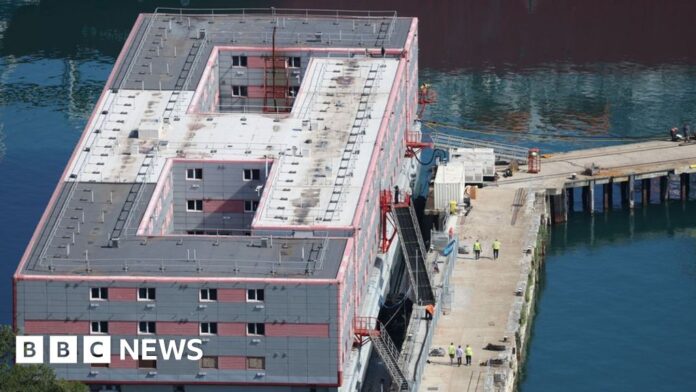

Migrants are being temporarily removed from the Bibby Stockholm barge after traces of Legionella bacteria were found in the on-board water system.
The Home Office said all 39 migrants on board the vessel in Dorset would be disembarked by the end of Friday.
The Legionella bacteria can cause Legionnaires disease – a type of pneumonia.
The barge is a flagship plank of the government’s migration policy to cut the cost of housing asylum seekers.
It has not yet been revealed where those disembarking will be moved to temporarily.
One worried barge resident, who spoke to the BBC, said a few of the migrants on board had sore throats, and he himself had been coughing and having breathing problems.He said they had given samples but were not informed about any transfer or move to another facility.
The government eventually plans to house up to 500 men aged 18-65 on the barged moored in Portland Port, while they await the outcome of asylum applications.
A Home Office source has told the BBC that results showing “low levels” of legionella in the water system on the Bibby Stockholm were received by a contractor on Monday.It is understood the local council informed the Home Office on Wednesday evening, but at this stage the results being discussed were still “low levels”.On Thursday further results “changed the picture”. There was a discussion with the UK Health Security Agency (UKHSA) who advised that the six newly-arrived asylum seekers should be disembarked.
Further testing has been done – by Dorset Council’s environmental health team – and it is expected that migrants will be moved back only if and when the water supply is completely clear of contamination.
Ministers have said the barge would help cut the cost of housing asylum seekers being accommodated in hotels and described the barge as “perfectly acceptable”.
However, the initiative had already suffered a shaky start after delays over safety concerns and legal challenges had frustrated ministers’ attempts to ramp up the numbers of people boarding the barge.
This video can not be played
To play this video you need to enable JavaScript in your browser.
Government sources have said they are complying with the UK Health Security Agency guidance and have gone “above and beyond” what has been recommended by removing people from the barge temporarily.
A Home Office spokesman said: “No individuals on board have presented with symptoms of Legionnaires’, and asylum seekers are being provided with appropriate advice and support.
“The samples taken relate only to the water system on the vessel itself and therefore carry no direct risk indication for the wider community of Portland nor do they relate to fresh water entering the vessel. Legionnaires’ disease does not spread from person to person.”
Campaigners were quick to hit out at the government over the development.
A charity representing asylum-seekers, Care4Calais, said its concerns over the safety of the barge had been justified. The charity is supporting a number of asylum seekers in legal challenges against being moved to the barge.
Alex Bailey from the Say No To The Barge campaign group said the news was “another example of the haphazard, incompetent way our government has approached this scheme from start to finish”.
Immigration minister Robert Jenrick is understood to have been chairing meetings about the situation.
Earlier this week he described accommodation on board the barge as “decent” but said there was “not a menu of options” for those seeking state-funded help as they sought asylum.
“We’ve got to be fair to the taxpayers as well as decent and compassionate to the individuals concerned.”
What are the risks of Legionella bacteria?
Follow BBC South on Facebook, Twitter, or Instagram. Send your story ideas to south.newsonline@bbc.co.uk.
You can receive Breaking News on a smartphone or tablet via the BBC News App. You can also follow @BBCBreaking on Twitter to get the latest alerts.