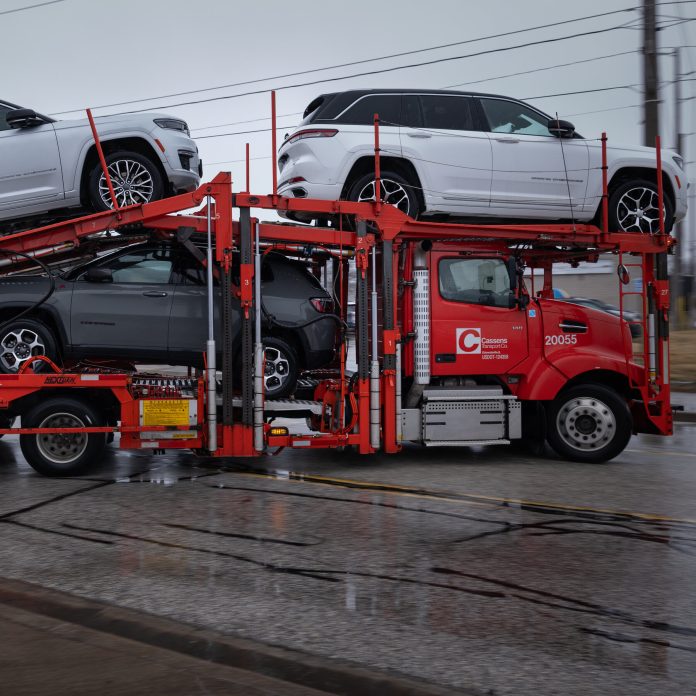

The company, which owns Jeep, Peugeot, Fiat and other brands, said it might soon have to begin raising prices.
Stellantis, the maker of Chrysler, Jeep and Ram vehicles, reported a big loss on Monday, which it blamed, in part, on President Trump’s tariffs.
The company, which also owns European brands like Peugeot, Fiat and Opel, said it lost 2.3 billion euros ($2.7 billion) in the first half of the year after revenue fell 13 percent to €74.3 billion.
Tariffs cost the company €300 million, Stellantis said, while factory shutdowns related to Trump trade policies contributed to a 25 percent decline in the number of cars delivered to U.S. buyers. Tariffs may soon force the company to begin raising car prices, Doug Ostermann, the company’s chief financial officer, said during a conference call on Monday.
“Tariffs are inherently inflationary,” he said.
In April, Stellantis paused production for several weeks at plants in Mexico and Canada that supply cars and parts to the United States. The company said at the time it was bracing for the effect of the 25 percent tariffs on imported vehicles imposed by Mr. Trump.
Stellantis published the preliminary results on Monday, more than a week ahead of schedule, saying it needed to correct market expectations. Stellantis has been struggling with poor sales, unhappy dealers and management turmoil. In Europe, Stellantis is under pressure from Chinese automakers that are offering high-quality vehicles at attractive prices.
Carlos Tavares resigned as chief executive in December. He was replaced by Antonio Filosa, who had managed Stellantis operations in the Americas.
Stellantis and other carmakers have delayed raising car prices in response to tariffs, Mr. Ostermann said, because they still have supplies of vehicles produced before the duties began. But, he said, “I think we’re coming to the end of that period.”
Mr. Ostermann said he expected the company’s performance to improve later in the year as it introduces new models, including a reincarnation of the Jeep Cherokee, a once popular model that it stopped offering in 2023.
Stellantis is less vulnerable to tariffs than other automakers based in the United States, analysts at Bernstein, an investment and research firm, said in a note to clients. “However,” the analysts said, “in the short-term the company has not yet dealt with its declining U.S. sales successfully.”
Mr. Ostermann acknowledged that the company still had a lot of work to do. “Certainly the management team is not happy with where we’re at,” he said.