

The Senate sent its deal to fund most of the Department of Homeland Security back to the House Thursday morning — marking what should be the beginning of the end of a historic partial government shutdown.
The Senate’s action, taken in a mostly empty chamber just after 7 a.m., came less than a day after President Donald Trump effectively endorsed a two-track strategy for DHS: funding most of it through a bipartisan deal with Democrats then using the party-line budget reconciliation process for immigration enforcement activities.
That means undertaking a redo of the bill Senate Majority Leader John Thune moved through the Senate last week only to see it rejected by the House, where conservatives balked at separating out enforcement funding.
Now the bill is headed back across the Capitol. The Senate approved Thune’s motion Thursday to set aside the House’s plan, an eight-week all-DHS stopgap, and instead give it a second chance to pass the Senate bill, which omits funding for ICE and parts of Customs and Border Protection that Democrats oppose.
Speaker Mike Johnson signed off Wednesday on the two-track strategy, effectively capitulating after torching the Senate bill Friday as a “joke.” But he could still struggle to move it quickly given early opposition from some members on the right flank of his conference.
While the House will convene for a brief session Thursday morning, it will only take one member to prevent the DHS funding bill from passing, and leaders are not expected to attempt it. Johnson will likely have two more opportunities next week, otherwise he will need to wait until all of his members are back and the chamber is fully in session April 14.
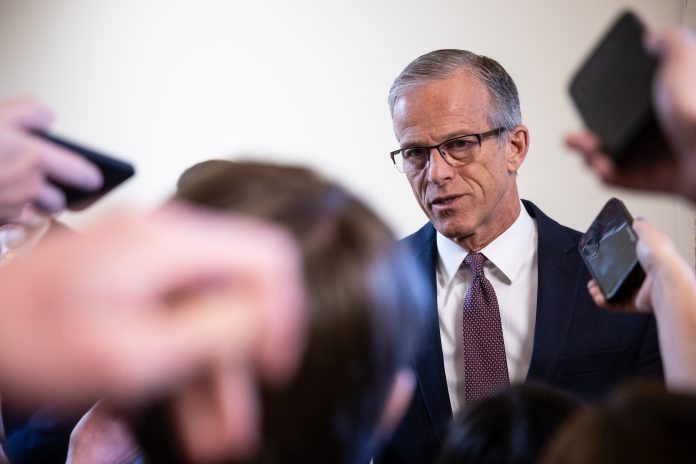
Asked Thursday how he revived the deal, Thune said, “You … have to just continue to define reality for people, what’s achievable in the Senate, what we can get done.”
Leaving out ICE and CBP funding comes after Republicans and Democrats could not agree, despite weeks of negotiations, on any new immigration enforcement restrictions in the wake of federal agents killing two people in Minneapolis in January.
“We were clear from the start: fund critical security, protect Americans, and no blank check for reckless ICE and Border Patrol enforcement,” Senate Minority Leader Chuck Schumer said in a statement Wednesday. “We were united, held the line, and refused to let Republican chaos win.”
Even once both chambers clear the Senate bill, they will face a tight timeline for the second part of the Trump-blessed plan, delivering an immigration enforcement bill to his desk by June 1.
House Republicans are expected to convene a conference call at 11 a.m. Thursday to talk through the DHS strategy, including assurances leaders have gotten from the White House and Senate about passing another reconciliation bill.
The Senate is expected to move first to approve a budget resolution that will unlock the GOP-only immigration bill, according to three people granted anonymity to disclose private strategy, and could adopt the fiscal blueprint for the final bill by the end of the month.
Thune said Thursday he has already had conversations with Senate Budget Chair Lindsey Graham (R-S.C.) about how to move as quickly as possible.
“Our theory of the case behind all this was to keep that thing as narrow and focused as possible, and that maximizes, I think, the speed at which we can do it and the support for it,” he said.