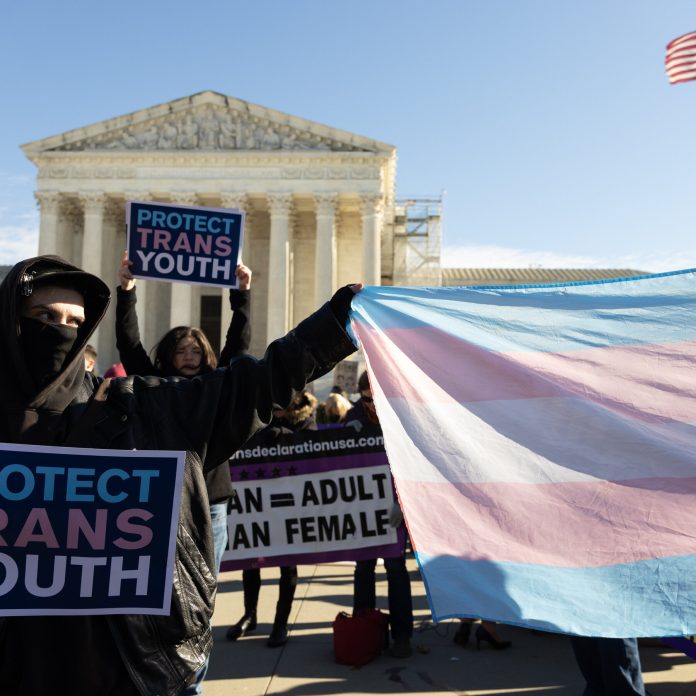

The decision to uphold the Tennessee law will most likely mean a patchwork of laws throughout the country, a map that traces current political polarization.
The Supreme Court on Wednesday upheld a Tennessee law banning some types of medical care, including puberty blockers and hormone therapies, for transgender youth.
Here’s what we know so far about what the decision could mean.
The decision most likely allows 24 other states with similar bans to bar some treatments for transgender youth.
The justices, by a 6 to 3 vote, found that Tennessee could enact legislation that outlawed some types of medical care for transgender youth. In all, twenty-five states restrict doctors from providing puberty blockers, hormone therapies or surgery to transgender minors. Two other states, New Hampshire and Arizona, ban only surgeries.
The court announced that it believed the Tennessee law, which is similar to the other states’ measures, was constitutional. In the majority opinion, the justices said it was not the court’s role “to judge the wisdom, fairness or logic” of the state’s law, declining to delve into the scientific debate around the treatments. Such policy questions, the justices said, should be left to the democratic process.
The court’s decision will not directly affect states without bans.
The court’s decision focused narrowly on the Tennessee law banning transgender care. The states that allow medical treatment for transgender youth — many of them Democratic-led states on the West Coast and in the Northeast — will be able to continue providing such treatment.
In practical terms, that means there will most likely be a patchwork of laws throughout the country governing transgender youth and medical care, a map that follows the country’s current political polarization. The decision also does not weigh in on transgender care for adults.
The decision did not overturn the Supreme Court’s previous major ruling on transgender rights.
In its decision, the court’s majority took pains to explain that its ruling in a previous case decided in 2020, Bostock v. Clayton County, was not affected by the transgender medical care ruling.
In that case, a 6-to-3 decision written by Judge Neil M. Gorsuch, a conservative, the court found that a landmark civil rights law, Title VII of the Civil Rights Act, shielded gay and transgender people from workplace discrimination.
In the Tennessee decision on Wednesday, the majority wrote that the court did not determine whether the reasoning in the Bostock workplace discrimination case would extend beyond the types of employment cases that they previously found were protected by the statute.
It remains unclear how this decision will affect other laws on transgender issues.
In the majority opinion upholding the Tennessee law, the justices described their decision as a narrow ruling focused on whether that state’s law violated equal protection principles.
That leaves open the question of how the ruling might play out for other legal and policy fights around transgender rights, including around military service, athletics and bathroom access.