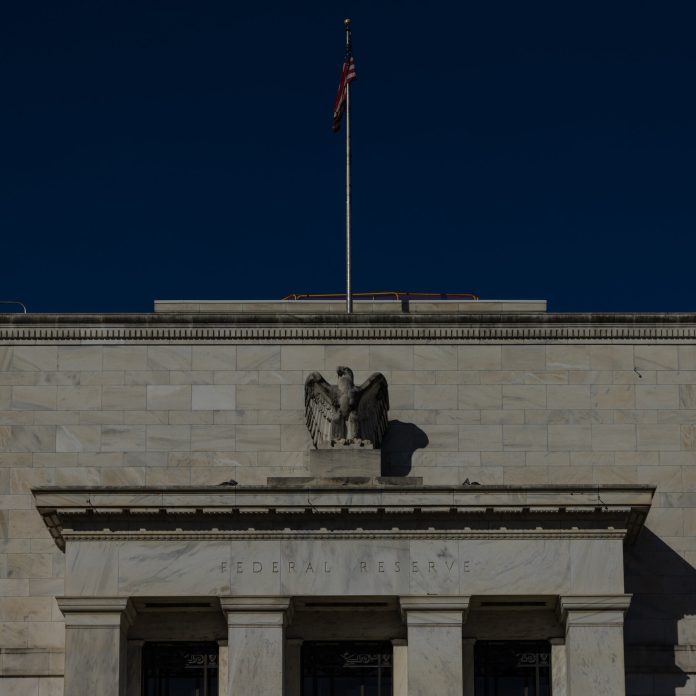

Live Updates: Fed Expected to Keep Rates Steady
The Federal Reserve is likely to continue waiting for more clarity on the effects of tariffs, taxes and other policies before it resumes cutting interest rates.

The Federal Reserve is expected to hold interest rates steady at the conclusion of its latest meeting on Wednesday, extending a pause that has been in place since January. Officials have assumed a wait-and-see approach until they have more clarity on how President Trump’s trade war, immigration crackdown and plans to slash taxes, among other policies, will effect the economy.
The Fed will issue its policy statement at 2 p.m. Eastern time, along with new economic projections and estimates for where policymakers expect to see interest rates through 2027 and over the longer run. Jerome H. Powell, the Fed chair, will hold a news conference at 2:30 p.m.
Here’s what to know ahead of the Fed’s decision:
-
The federal funds rate stands at a range of 4.25 percent to 4.5 percent, where it has been since January. That pause is likely to extend throughout the summer, potentially giving the Fed at least a couple more months before it must make a difficult decision about when and by how much to lower borrowing costs. Fed officials cut rates three times last year, for a total percentage point reduction.
-
The Fed’s most recent economic projections, in March, showed most officials paired a higher inflation forecast with a lower forecast for economic growth.
-
Back then, officials stuck with previous predictions that they would be able to lower interest rates half a percentage point this year, implying two quarter-point cuts.
-
The updated projections are likely to calcify warnings made by officials in recent weeks that Mr. Trump’s policies could lead to an economic outcome that resembles stagflation, the combination of high inflation and sluggish growth.
-
Officials are still likely to see a path to lower rates this year, but economists are split on whether policymakers will forecast one or two cuts by the end of the year.
-
This gradual approach to rate cuts is likely to anger Mr. Trump, who just hours before the Fed’s rate decision revived his attacks on Mr. Powell and called on the central bank to cut rates by as much as 2.5 percentage points. “I do it every way in the book,” Mr. Trump said of his pressure on Mr. Powell. “I’m nasty. I’m nice. Nothing works. He’s like just a stupid person.”

As President Trump’s trade policies ripple through the economy, companies are increasing prices, cutting staff, reworking supply chains and making other adjustments. They say that the moves are necessary because more consumers are starting to pull back their spending.
Retail sales slipped in May, data released on Tuesday showed, weighed down by a sharp decline in purchases of vehicles and building materials. That may reflect the hangover from an earlier surge of spending on big-ticket items before tariffs took effect. But restaurants and bars also saw a drop in sales last month.
A recent survey by McKinsey found that inflation and tariffs were the biggest sources of concern for Americans. Most respondents said they were changing their spending habits because of tariffs.
Several companies have noted a shift starting to show in their businesses. JetBlue’s chief executive said in a memo to staff on Monday that it has scaled back its operations as weaker demand for travel disrupts its plans for the year. Walmart, which warned that tariffs could spur higher prices, recently flagged “negative consumer sentiment” as having an impact.
As officials at the Federal Reserve monitor how the economy is reacting to Mr. Trump’s trade war, this is what some companies have said about prices, spending and the effect of government policies:
-
JetBlue: The airline is reducing flight schedules, reorganizing its leadership team and pausing cabin refurbishments “to match weaker demand,” Joanna Geraghty, the company’s chief executive, wrote in a memo to staff on Monday.
-
Procter & Gamble: The consumer goods giant said this month that it plans to cut 7,000 jobs, or about 15 percent of its nonmanufacturing work force. The company has said that it would probably raise some prices to mitigate the effects of tariffs, which it estimated would cost it around $600 million in its current fiscal year.
-
Walmart: Consumer confidence has deteriorated because of “looming tariffs” and “immigration noise,” the retailer’s chief financial officer, John Rainey, said at an investor conference last week. Walmart warned last month that tariffs would soon force it to raise prices because it could not “absorb” all of the costs. In response, Mr. Trump called on Walmart to “EAT THE TARIFFS” and not pass the costs on to consumers.
-
Lululemon: The clothing brand known for its leggings saw its shares tumble earlier this month after it said that it experienced lower traffic in its U.S. stores in its latest quarter because of economic uncertainty and inflationary pressures. It also cut its full-year profit forecast as “the current tariff paradigm has brought uncertainty into the retail environment,” Calvin McDonald, Lululemon’s chief executive, told investors on a call.
-
Mattel: The maker of Barbie and other toys said last month that it would increase prices in response to tariffs on imports from China. Mattel also scrapped its financial forecast for the year.
Advertisement

Stocks inched higher on Wednesday morning and oil prices eased, as investors grew hopeful of a de-escalation in the conflict between Israel and Iran. Government bond yields and the dollar also fell, but the moves were muted, which is typical for markets before a big event like the Fed meeting.
The Fed’s decision on interest rates today seems relatively straightforward. Inflation has yet to surge, as many policymakers and economists expect will soon happen because of President Trump’s tariffs. And the labor market, while softer than just a couple of months ago, is still on solid footing. This backdrop has reinforced the Fed’s stance that it can afford to take its time on making big policy moves, especially when it is not yet clear exactly how the president’s policies are going to alter the outlook.


The Federal Reserve is expected to keep its key rate steady on Wednesday, after a series of cuts that lowered rates by a full percentage point last year.
That means consumers looking to borrow are likely to have to wait a bit longer for better deals on many loans, but savers will benefit from steadier yields on savings accounts.
The central bank has kept its benchmark rate unchanged since January. President Trump’s frequently changing stance on tariffs, along with the broader effects of his restrictive immigration policies and widespread federal job cuts, have made forecasting a challenge.
“Until policymakers get some clarity on these policies,” Mark Zandi, chief economist of Moody’s Analytics, said in a note, “they will not know the appropriate monetary policy response and have thus put any further interest rate cuts on hold.”
Mr. Trump has publicly attacked the Fed chair, Jerome H. Powell, and his colleagues for not lowering borrowing costs. But the rate-setting committee has signaled it will first need to see clear signs that the job market is softening.
The Fed’s benchmark rate is set at a range of 4.25 to 4.5 percent. In an effort to tamp down inflation, the central bank began lifting rates rapidly — from near zero to above 5 percent — between March 2022 and July 2023. Prices have cooled considerably since then, and the Fed pivoted to rate cuts, lowering rates in September, November and December.
But economists expect Mr. Trump’s tariffs to trickle through to prices by this summer, pushing inflation higher.
Auto Rates
What’s happening now: Auto rates have been trending higher and car prices remain elevated, making affordability a challenge. And that is before U.S. tariffs threaten to push prices up even more.
Car loans tend to track with the yield on the five-year Treasury note, which is influenced by the Fed’s key rate. But other factors determine how much borrowers actually pay, including your credit history, the type of vehicle, the loan term and the down payment. Lenders also take into consideration the levels of borrowers becoming delinquent on auto loans. As those move higher, so do rates, which makes qualifying for a loan more difficult, particularly for those with lower credit scores.
The average rate on new car loans was 7.3 percent in May, according to Edmunds, a car shopping website, up slightly from April and unchanged from My 2024. Rates for used cars were higher: The average loan carried an 11 percent rate in May, largely unchanged from April and down slightly from 11.5 percent in May 2024.
Where and how to shop: Once you establish your budget, get preapproved for a car loan through a credit union or bank (Capital One and Ally are two of the largest auto lenders) so you have a point of reference to compare financing available through the dealership, if you decide to go that route. Always negotiate on the price of the car (including all fees), not the monthly payments, which can obscure the loan terms and what you’ll be paying in total over the life of the loan.
Credit Cards
What’s happening now: The interest rates you pay on any balances that you carry had edged slightly lower after the most recent Fed cuts, but the decreases have slowed, experts said. Last week, the average interest rate on credit cards was 20.12 percent, according to Bankrate.
Much depends, however, on your credit score and the type of card. Rewards cards, for instance, often charge higher-than-average interest rates.
Where and how to shop: Last year, the Consumer Financial Protection Bureau sent up a flare to let people know that the 25 biggest credit-card issuers had rates that were eight to 10 percentage points higher than smaller banks or credit unions. For the average cardholder, that can add up to $400 to $500 more in interest a year.
Consider seeking out a smaller bank or credit union that might offer you a better deal. Many credit unions require you to work or live someplace particular to qualify for membership, but some bigger credit unions may have looser rules.
Before you make a move, call your current card issuer and ask them to match the best interest rate you’ve found in the marketplace that you’ve already qualified for. And if you do transfer your balance, keep a close eye on fees and what your interest rate would jump to once the introductory period expires.
Mortgages
What’s happening now: Mortgage rates have been volatile. Rates peaked at about 7.8 percent late last year and had fallen as low as 6.08 percent in late September. Solid economic data and concerns about Mr. Trump’s potentially inflationary agenda pushed rates a bit higher again, though they’ve steadied in recent weeks.
Rates on 30-year fixed-rate mortgages don’t move in tandem with the Fed’s benchmark, but instead generally track with the yield on 10-year Treasury bonds, which are influenced by a variety of factors, including expectations about inflation, the Fed’s actions and how investors react.
The average rate on a 30-year fixed-rate mortgage was 6.84 percent as of June 12, down from 6.85 percent the previous week and 6.95 percent a year ago.
Other home loans are more closely tethered to the central bank’s decisions. Home-equity lines of credit and adjustable-rate mortgages — which carry variable interest rates — generally adjust within two billing cycles after a change in the Fed’s rates.
Where and how to shop: Prospective home buyers would be wise to get several mortgage rate quotes — on the same day, since rates fluctuate — from a selection of mortgage brokers, banks and credit unions.
That should include: the rate you’ll pay; any discount points, which are optional fees buyers can pay to “buy down” their interest rate; and other items like lender-related fees. Look to the “annual percentage rate,” which usually includes these items, to get an apples-to-apples comparison of your total costs across different loans. Just be sure to ask what’s included in the A.P.R.
Savings Accounts and C.D.s
What’s happening now: Everything from online savings accounts and certificates of deposit to money market funds tend to move in line with the Fed’s policy.
Savers are no longer benefiting from the juiciest yields, but you can still find returns at online banks of 4 percent or more. “The Fed taking its foot off the gas with rate cuts means that these yields are likely to stay high for a while, but it won’t last forever,” said Matt Schulz, chief consumer finance analyst at LendingTree, the online loan marketplace.
Traditional commercial banks’ yields, meanwhile, have remained anemic throughout this period of higher rates. The national average savings account rate was recently 0.6 percent, according to Bankrate.
Where and how to shop: Rates are one consideration, but you’ll also want to look at providers’ history, minimum deposit requirements and any fees (high-yield savings accounts don’t usually charge fees, but other products, like money market funds, do). DepositAccounts.com, part of LendingTree, tracks rates across thousands of institutions and is a good place to start comparing providers.
Check out our colleague Jeff Sommer’s columns for more insight into money-market funds. The yield on the Crane 100 Money Fund Index, which tracks the largest money-market funds, was 4.1 percent as of Monday, down from 5.13 percent at the end of last June.
Student Loans
What’s happening now: There are two main types of student loans. Most people turn to federal loans first. Their interest rates are fixed for the life of the loan, they’re far easier for teenagers to get and their repayment terms are more generous.
Rates are about to drop modestly on student loans for the first time in five years, for money borrowed from July 1 through June 30 of next year. Undergraduate loans will now carry a rate of 6.39 percent, down from 6.53 percent. Rates on loans for graduate and professional students eased to 7.94 percent, from 8.08 percent, while rates on PLUS loans — extra financing available to graduate students and to parents of undergraduates — fell to 8.94 percent, from 9.08 percent.
These rates reset on July 1 each year and follow a formula based on the 10-year Treasury bond auction in May.
Private student loans are a bit of a wild card. Undergraduates often need a co-signer, rates can be fixed or variable and much depends on your credit score.
Where and how to shop: Many banks and credit unions want nothing to do with student loans, so you’ll want to shop around extensively, including with lenders that specialize in private student loans.
You’ll often see online ads and websites offering interest rates from each lender that can range by 15 percentage points or so. As a result, you’ll need to give up a fair bit of information before getting an actual price quote.
Ann Carrns contributed reporting.
Advertisement
Federal Reserve officials are scheduled to release a fresh set of economic projections alongside their interest rate decision on Wednesday. Those forecasts will offer a glimpse of the path for monetary policy at a highly uncertain moment for the central bank.
Policymakers paused interest rate cuts in January after reducing borrowing costs by a percentage point in the latter half of last year. The Fed has embraced a “wait and see” approach since that point, seeking to gather more evidence about how President Trump’s policies — from his global trade war to his immigration crackdown — will affect the economy.
Officials are expected to again keep rates steady on Wednesday. The big question now is when — and to some extent whether — the Fed will restart cuts this year.
When the Fed last released quarterly economic projections in March, officials penciled in two rate cuts that would reduce borrowing costs by half a percentage point in 2025. They also raised their forecasts for inflation while trimming those for growth and employment as they factored in the economic risks associated with Mr. Trump’s plans.
But that was before Mr. Trump’s April 2 announcement of steep tariffs across the globe, including on some of America’s biggest and most important trading partners. Those levies have been paused as the United States tries to reach trade deals with dozens of countries before a July 8 deadline, at which point the tariffs may snap back into place.
Here’s what could change on Wednesday and how to interpret those updates.
The dot plot, decoded.
When the central bank releases its Summary of Economic Projections each quarter, Fed watchers focus on one part in particular: the dot plot.
The dot plot will show Fed policymakers’ estimates for interest rates through 2027 and beyond. The forecasts are represented by dots arranged along a vertical scale — one dot for each of the central bank’s 19 officials. While only 12 get to cast a vote each meeting, all 19 submit forecasts for interest rates and the economic outlook over the short and long terms.
Economists closely watch how the dots are shifting, because that can give a hint about where policy is heading. They fixate most intently on the middle, or median, dot. That is regularly quoted as the clearest estimate of where the central bank sees interest rates going over a given period.
The forecasts should be viewed cautiously. The dot plot does not represent a preset plan for policy, but rather a compilation of individual officials’ projections at a moment in time. At times, it serves as a helpful communications device, giving Jerome H. Powell, the Fed chair, yet another tool to shape expectations about the policy path forward. But when the economic outlook is highly uncertain, it can muddy the Fed’s message.
The central bank is trying to achieve two things when it sets policy: low, stable inflation and a healthy labor market.
When it perceives elevated inflation to be a concern, it raises interest rates to make borrowing money more expensive, which cools the economy. In March 2022, the Fed began to sharply raise interest rates in a bid to weaken demand and cool off a red-hot labor market. Eventually it became harder for companies to raise prices without losing customers, which eventually helped to tame inflation.
As price gains cooled and hiring slowed, officials began cutting rates in September 2024. They kicked off with a half-percentage-point reduction, larger than the typical quarter-point cut. Mr. Powell billed the move as one that would help to safeguard a strong economy, rather than a panicked response to unexpected weakness. The Fed lowered interest rates twice more in 2024, bringing borrowing costs down to the current level of 4.25 percent to 4.5 percent.
Economists are split on whether officials will retain their March forecast of two quarter-point cuts this year or forecast just one reduction. Three months ago, there was already wide dispersion among officials’ forecasts. Eight policymakers predicted either no cuts or just one. Two thought the Fed would announce three quarter-point cuts.
If most officials pencil in just one cut this year, that would be a hawkish signal suggesting that the central bank was chiefly concerned about the risk of higher inflation, as opposed to a weaker economy.
How restrictive are interest rates?
When you read the dot plot, it’s important to pay attention to where interest rate estimates fall in relation to the longer-run median projection. That number is sometimes called the “natural” or “neutral” rate. It represents the theoretical dividing line between monetary policy that is set to speed up the economy and a policy meant to slow it down.
The neutral estimate has steadily ticked higher in the past year and in March stood at 3 percent.
Mr. Powell and other officials have continued to suggest that interest rates at current levels are “restrictive” to some degree, suggesting that the Fed sees its policy settings as continuing to weigh on the economy and helping to bring down inflation. Economists will be watching whether the chair changes his tune on that point.
They will also look to see if officials again raise their forecasts for the neutral rate, perhaps to just above 3 percent. That may reflect the fact that, so far, the economy has held up relatively well despite a long period of elevated interest rates, changing conceptions of the level of borrowing costs that neither revs up growth nor slows it down.
Beth Hammack, president of the Federal Reserve Bank of Cleveland, said in a recent interview that she thought the central bank’s current settings were not far from that point.
The labor market looks healthy, she said, and with inflation not yet back to the Fed’s 2 percent target, “it feels like you’re supposed to be in a somewhat restrictive posture to make sure that we’re meeting both sides of the mandate.”
Stagflationary shock ahead?
At the Fed’s last meeting in May, the staff had grown much more downbeat about the economic outlook. It warned that a recession was “almost as likely” as its forecast for subdued growth.
The staff also raised inflation expectations from the March estimates. Fed staff said it expected Mr. Trump’s levies to boost inflation “markedly this year” and continue to put upward pressure on prices in 2026 before inflation trended back to the 2 percent target by 2027. That combination of higher inflation and sluggish economic growth carries the whiff of stagflation.
Officials are likely to incorporate some of those risks into their forecasts on Wednesday.
In March, policymakers saw the economy growing only 1.7 percent this year, down from a 2.1 percent forecast in December. They also predicted that the unemployment rate would rise to 4.4 percent. Officials lifted their forecasts for core inflation, which strips out volatile food and energy prices, to 2.8 percent, too. Back in December, they expected it to end the year at 2.5 percent, already a big step up from earlier estimates.
Now, the unemployment rate stands at 4.2 percent and core inflation, per the latest Personal Consumption Expenditures price index from April, at 2.5 percent.
Economists are bracing for Fed officials to again raise their forecast for inflation while marking down their estimates for growth and employment, reflecting the expectation that tariffs and Mr. Trump’s other policies will stoke price pressures while weighing on demand.

If the Federal Reserve leaves interest rates unchanged as expected on Wednesday, it will be an outlier among major central banks.
Policymakers at the European Central Bank, the Bank of Canada and other central banks have all announced rate cuts in recent months, largely in response to the effects of President Trump’s trade war, which is expected to slow global growth.
Fed officials are also worried about trade and how tariffs and other policies might affect the economy, but they have adopted a wait-and-see approach in order to better understand the impact of his policies. Fed officials cut rates three times last year, by a total of one percentage point, but have been on pause since.
The European Central Bank, by contrast, has cut rates eight times over the past 12 months, by a total of two percentage points. The Bank of Canada has cut rates seven times, by a total of two and a quarter points, over a similar period.
The fact that other global central banks are cutting more regularly than the Fed has galvanized Mr. Trump and underscored the tricky decision facing Jerome H. Powell, the Fed chair. Mr. Trump has increasingly pointed to the Fed’s peers as he tries to jawbone Mr. Powell into cutting rates, referring to him as “Too Late.”
“I call him ‘Too Late Powell’ because he’s always too late,” Mr. Trump said at the White House on Wednesday, just hours before the Fed announces its latest decision on rates.
“He probably won’t cut today,” Mr. Trump said, adding that the Fed should cut rates by 2.5 percentage points, which would be one of the biggest moves in the central bank’s history.
“I don’t expect anything, maybe he does a little bit,” he said, noting that central banks in Europe had cut more often.
Mr. Trump has long beaten up on the Fed and Mr. Powell for not cutting rates quickly enough for his liking. Last month, for example, Mr. Trump cited rate cuts in Europe and China and posted on social media: “What is wrong with Too Late Powell? Not fair to America, which is ready to blossom? Just let it all happen, it will be a beautiful thing!”
But the Fed is grappling with a different set of economic factors than other large economies as it tries to keep inflation stable despite steep U.S. tariffs and maintain a solid labor market. Inflation remains above the Fed’s 2 percent target and officials have expressed concern that Mr. Trump’s tariffs could reignite price gains. At the same time, the labor market is showing some signs of softening, putting its goals in tension.
That balancing act seems to matter little to Mr. Trump, who on Wednesday floated another idea: “Am I allowed to appoint myself to the Fed?” he asked, somewhat facetiously, before repeating that rates should be slashed.