
Live Updates: In Chaotic Economy, Hiring Remained Steady in May
Employers added 139,000 jobs last month, continuing a steady run of hiring despite policy turmoil. The unemployment rate was unchanged at 4.2 percent.

The labor market persevered in May, continuing a consistent run of job creation that has outlasted inflation, interest rate increases and now an on-again-off-again trade war.
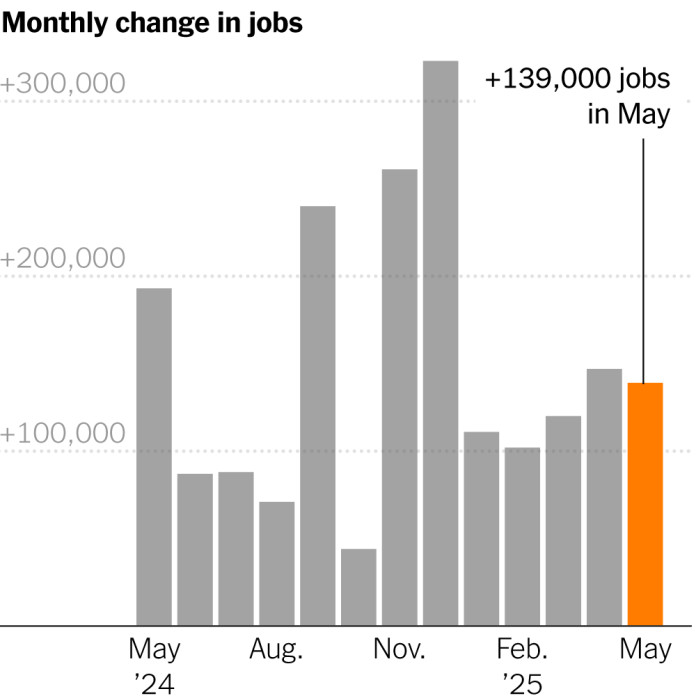
Employers added 139,000 jobs last month, the Labor Department reported Friday, about in line with economists’ expectations. The unemployment rate remained at 4.2 percent.
The steady hiring is an indication that businesses are still seeing enough demand for goods and services that they will fill open roles and add new ones, even if they’re no longer expanding as quickly as they had over the past few years.
The growth stemmed mostly from health care and social assistance, which added 78,000 positions, as well as leisure and hospitality, at 48,000. Most other sectors were flat, including manufacturing, which shed 8,000 jobs.
That lopsidedness suggests that growth isn’t as broad-based as economists might like. Growth in health care is fueled in large part by the aging of the U.S. population; it is not always a reliable measure of the strength of the overall economy.
“Outside of really health care and social assistance, there isn’t that much hiring demand across the economy,” said Sam Kuhn, an economist at the digital recruiting firm Appcast. He noted that the annual average pace of job growth, outside the pandemic downturn, is lower than it’s been in over a decade.
-
Fading spring: The number of jobs created in March and April was revised down by a combined 95,000, suggesting that the start of the year was weaker than it appeared initially.
-
DOGE effect: The federal government shed 22,000 jobs in May and is down 59,000 since January. That’s not counting those on administrative leave, or who were let go when federal contracts were cut.
-
Wages still strong: Average hourly earnings rose 0.4 percent from a month earlier, a bigger gain than expected. Hourly earnings are up 3.9 percent from last year.
-
People dropping out: Labor force participation was a weak spot in the report. The share of people age 25 to 54 who were working or looking for work dropped to 83.4 percent and now looks to have plateaued after nearing a two-decade high.
-
What they’re saying: Lindsay Rosner, of Goldman Sachs Asset Management, said this was too strong a report to allow the Fed to cut interest rates soon. “With the Fed laser-focused on managing the risks to the inflation side of its mandate, today’s stronger-than-expected jobs report will do little to alter its patient approach,” she wrote in a note to clients.

In a second social media post on Friday about the Fed, President Trump said Powell is costing the country a “fortune,” as he re-upped his demand for the central bank to lower borrowing costs.
“If ‘Too Late’ at the Fed would CUT, we would greatly reduce interest rates, long and short, on debt that is coming due,” Mr. Trump wrote, using his nickname for Powell. “There is virtually no inflation (anymore), but if it should come back, RAISE “RATE” TO COUNTER.”
After the release of the jobs report, President Trump railed on Jerome H. Powell, the Fed chair, calling him a “disaster” and urging him to lower interest rates a percentage point. “’Too Late’ at the Fed is a disaster! Europe has had 10 rate cuts, we have had none,” he wrote on social media. “Despite him, our Country is doing great. Go for a full point, Rocket Fuel!”
Advertisement
A solid jobs report in May has reinforced the Federal Reserve’s stance that it can take its time before restarting interest rate cuts.
Officials paused in January amid extreme uncertainty about the economic outlook as a result of President Trump’s policies. The central bank has signaled it will need to see clear signs that the labor market is weakening before lowering rates again, a higher bar than in the past given expectations that inflation could reignite later this year.
The Fed’s caution is likely to put it on a collision course with Mr. Trump, who has repeatedly urged the central bank to cut interest rates. He did so again on social media on Friday, calling Jerome H. Powell, the Fed chair, “a disaster” and suggesting policymakers should cut rates by a full percentage point.
“He is costing our Country a fortune,” Mr. Trump wrote in a second social media post. “Borrowing costs should be MUCH LOWER!!!”
For Fed officials, however, the big wild card is the president’s tariffs, the scope and scale of which have repeatedly changed since his return to office. That whiplash has left businesses and policymakers in limbo, uncertain how significantly these policies will cause prices to rise and growth to slow.
After reaching its lowest level in more than 50 years in 2022, unemployment has edged up as companies have slashed the number of available positions and slowed hiring. Fewer Americans are quitting their jobs, muting wage growth. Jobless claims are up, although layoffs have stayed low.
Friday’s data showed that the labor market is continuing to lose momentum but is not yet cracking: Employers added 139,000 jobs last month, and the unemployment rate was stable at 4.2 percent.
Haunted by pandemic-era staffing issues, companies appear hesitant to let go of employees. Instead, they have opted to cut back on hours or institute more flexible schedules.
That is the takeaway from Beth Hammack, president of the Federal Reserve Bank of Cleveland, who spoke to businesses across Cincinnati this week. She said she had heard nothing in those conversations to suggest that the Fed needed to immediately lower borrowing costs, even if business owners are on edge.
“I legitimately do not know which way this is going to break,” she said in an interview.
The labor market looks healthy, Ms. Hammack said, and with inflation not yet back to the Fed’s 2 percent target, she suggested that interest rates should be at a high enough level to continue weighing slightly on demand.
“I would rather wait and move quickly to play catch-up if I really don’t know what the right next move is,” Ms. Hammack added. “And right now, I really don’t know what the right next move is based on all of the information and policies that we’re responding to.”

The stock market opened higher after the robust jobs data, with the S&P 500 up just over 1 percent in a broad rally with roughly two-thirds of the index rising. Treasury yields, which underpin interest rates throughout the economy, rose.
“The jobs market has slowed, but it hasn’t ground to a halt,” said Ellen Zentner, the chief economic strategist at Morgan Stanley Wealth Management. “While the report confirmed the cooling trend we saw in almost all of this week’s data, continued labor market resilience could help the economy sidestep recession.”
Advertisement

Cuts to federal government jobs were offset by gains in state and local government jobs in May: the federal government shed 22,000 jobs while state and local governments added 21,000, resulting in a decline of 1,000 jobs in the government sector overall.
Job growth was otherwise concentrated in two sectors: education and health, and leisure and hospitality.

Employment at temporary help agencies fell 20,000 jobs in May. Economists often consider declines in temporary hiring to be an early sign of softness in the labor market because companies are less reluctant to cut temps than permanent employees.
The data appears to have reassured investors worried that the economic impact of some of the administration’s policies would start to be more clearly seen in the jobs data today. “Although there are clearly cracks forming and employment data is likely to show clearer signs of softening towards the end of summer, this is not a labor market which is starting to fall apart at the seams,” said Seema Shah, the chief global strategist at Principal Asset Management.

President Trump appeared to herald the new jobs report Friday in a social media post, even though he did not reference the figures directly, saying: “AMERICA IS HOT! SIX MONTHS AGO IT WAS COLD AS ICE! BORDER IS CLOSED, PRICES ARE DOWN. WAGES ARE UP!”
Advertisement
Job growth was solid in May, but it wasn’t particularly broad-based. In fact, the “diffusion index,” which measures the breadth of hiring, was exactly 50 in May, indicating that just as many industries were cutting jobs as adding them. The index was over 60 in December.
Spring job growth looks a little weaker after the numbers for March and April were revised down by a combined 95,000 jobs. Taking a longer view, the gain of 139,000 jobs in May now looks pretty similar to the average of 149,000 over the prior 12 months.
The Fed’s gradual approach to interest rate cuts has put it squarely at odds with the president, who demanded again this week that the central bank lower borrowing costs. President Trump also revived an insult he has directed at Jerome H. Powell, the Fed chair, calling him “‘Too Late’ Powell.”
The unemployment rate held steady, but other measures from the monthly survey of households were less encouraging. The labor force shrank by 625,000 in May, and the participation rate — the share of adults working or looking for work — fell by two tenths of a point.
Advertisement
The May jobs report reinforces the Fed’s wait-and-see approach to further interest rate cuts. With inflation concerns mounting, officials want more clarity on Mr. Trump’s policies and their implications for the economy. The latest data all but guarantees the central bank will again opt against an interest rate cut when it next meets later this month.
Job growth in March and April was revised down by a combined 95,000 jobs.
The immediate market reaction has been positive, with stocks rising. Bond yields also nudged higher, which means prices fell, but the move was modest.
The numbers are out! U.S. employers added 139,000 jobs in May, and the unemployment rate held steady at 4.2 percent.
Advertisement
Stocks and bonds are muted ahead of the fresh jobs data. It’s typical for investors to hold off making big bets before a significant data announcement like the labor market report. Futures on the S&P 500, which allow investors to bet on the market before the official start of trading, nudged higher, while Treasury yields traded roughly flat for the day.
The jobs report comes on the final day before officials at the Federal Reserve enter a communications blackout, when their public remarks on monetary policy are limited. The central bank is due to meet on June 17-18 and is widely expected to extend a pause in interest rate cuts that began in January.
Some bond analysts are warning that the market is positioned for a big move after the numbers are released. This is based on positioning in derivatives markets, where investors place trades to either bet on which direction the market will move after the numbers are released, or to protect themselves from a sharp move that could otherwise cost them.
The jobs numbers haven’t yet landed, but President Trump still took to social media to herald what he described as a strong economy. “Prices are down, income is up, our Border is closed, gasoline is CHEAP, inflation is DEAD — Our Country is BOOMING! Companies are pouring into America like never before!” he wrote. (For one thing, inflation cooled slightly in April, but the figures do not reflect an expected uptick in prices from the president’s tariffs.)
Advertisement

Stocks have rallied. Bond yields have eased. The worst of the market pain that was whipped up in the wake of President Trump’s high tariffs and expensive tax bill appears to have abated.
In April, the S&P 500 had six days in which the index fell by more than 1 percent — more than a quarter of all trading days that month. Last month, the same thing happened only once, on May 21.
Yet despite the appearance of calm, worries over the potential impact of the government’s policies — like tariffs, government spending and federal staffing cuts — still lurk in some of the less-watched corners of financial markets.
“The recovery seems at odds with an economic backdrop characterized by slower growth, higher inflation and lingering policy uncertainty,” said Seema Shah, chief global strategist at Principal Asset Management.
A surprisingly weak jobs report on Friday could bring these concerns to the surface, while a stronger-than-expected number is more likely to be discounted by investors as a continuation of the current trend, analysts said.
BeiChen Lin, senior investment strategist at Russell Investments, said that if Friday’s report “shows less than 100,000 jobs ended up being created, I think that’s where the equity market anxiety might come back.”
While the S&P 500 rose sharply in May, it peaked in the middle of the month. Much of the recent rally has also been powered by just a handful of big technology firms, masking the more muted rise for the rest of the market.
Stock benchmarks that are more sensitive to the economic outlook than the S&P 500 have had a more subdued recovery in recent weeks, reflecting lingering worries about a potential downturn. Whipsaw moves in bond, currency and gold markets have also prompted heightened investor caution.
With so much still uncertain about the government’s economic policies, investors are somewhat paralyzed. They are both worried about what may lie ahead, but also optimistic about a positive path forward.
That optimism is underpinned by recent economic data that remains solid. The worry is that it could turn.
Can we still trust the data coming out of the Trump administration?
It’s a question I get all the time — on social media, in comments on my stories, in conversations with friends and colleagues. That skepticism has only intensified in recent days, since the Bureau of Labor Statistics disclosed that it was cutting back collection of price data that feeds into the Consumer Price Index.
Here’s my answer: Yes, I still trust the data. But with some important caveats.
Many of the people asking this question are worried about the possibility of political interference in the data-collection or analysis process. There is no evidence that is happening. Major economic reports on inflation, spending, trade and jobs have continued to come out as normal, even when the news has been potentially damaging to the president (such as when the Bureau of Economic Analysis reported that gross domestic product shrank in the first quarter).
I have spoken to people inside these agencies, and to others who have recently left, and they consistently say they are confident that the numbers being released by the Bureau of Labor Statistics, Census Bureau and other agencies remain reliable. They also say that the longtime employees who oversee these statistics will blow the whistle if that changes. (Are you one of them? See our call-out at the end of this article.)
But while there is no evidence of political interference, many economists and other experts have a different concern: the gradual erosion in the quality of government statistics.
These concerns aren’t entirely new. Much of our economic data relies on surveys of individuals and businesses; response rates to those surveys have fallen sharply in recent years, as they have for surveys and polls conducted in the private sector.
Many statisticians believe the agencies need to adopt new methods that rely less on surveys and more on data from administrative records and private sources like credit card companies and payroll providers. But that transition would require substantial upfront investment, and the agencies have seen their budgets shrink in inflation-adjusted terms. A major report from the American Statistical Association last year warned that these long-running issues threatened the reliability of government statistics.
Those concerns have grown since President Trump returned to office. Administration officials have called into question the way the government collects data and calculates statistics, and the administration disbanded several advisory committees that provided input on statistical issues.
More directly, Mr. Trump’s freeze on federal hiring, combined with the buyouts he offered early in his term, has led to increased staff attrition at the statistical agencies. Staffing shortages appear to have been a factor in the Bureau of Labor Statistics’s recent cuts, according to information the agency provided by email to private-sector economists. Those emails were first reported by The Wall Street Journal.
Economists consistently say they still believe federal economic statistics. But they worry the numbers will gradually become more volatile and prone to larger revisions. That is bad news for policymakers, investors and anyone else who depends on accurate, timely data to make decisions.
Advertisement

Investors and central bankers will be closely watching the jobs report for signs of how the labor market is holding up amid President Trump’s trade war.
U.S. employers added 139,000 jobs in May, and the unemployment rate held steady at 4.2 percent. That’s solid growth, but it comes as companies move to pause hiring over uncertainty around economic growth and the fallout from tariffs.
Recent college graduates have been hit especially hard.Unemployment for those ages 22 to 27 rose to 5.8 percent in March, a four-year high, according to the Federal Reserve Bank of New York.Researchers attributed some of the difficulty finding jobs to larger societal shifts.
“While some of it is related to a normalization after the post-pandemic surge,” a recent report by Oxford Economics noted, “there are signs that entry-level positions are being displaced by artificial intelligence at higher rates.”
A data point to watch: Recent grads make up only 5 percent of the total work force, but they account for 12 percent of the 85 percent increase in the overall unemployment rate since mid-2023, according to Oxford Economics.
Layoffs are still relatively low, said Allison Shrivastava, an economist at the Indeed Hiring Lab. “But if you’re trying to get into the labor market right now, that’s where you’re really facing challenges,” she added. “And that’s where new grads are facing challenges.”
For recent grads, jobs are more scarce in the finance and tech sectors, including software development, Ms. Shrivastava said.
On Wednesday, research from the payroll company ADP reported that hiring in May slowed to its lowest level in more than two years. That said, the so-called JOLTS data from the Bureau of Labor Statistics showed an unexpected increase in job openings in April, and an uptick in hiring.
At the worst point of the labor shortage that emerged in the wake of the Covid-19 lockdowns, Thunderdome Restaurant Group had 100 people sign up for a job interview and only 15 show up. Of the two workers it hired, one never came in.
The job market has cooled significantly since then, and Joe Lanni, who runs the Cincinnati-based company with his brother, now faces a different dilemma: how to grow the business, which has over 50 locations, while controlling costs as concerns about the economy spread.
So they’re rethinking menu items like freshly made tortillas that require a dedicated full-time worker. They are also planning to shutter a handful of locations where sales have been softest, while adding more outposts of their fast casual restaurants that are doing well.
Uncertainty about the economy has skyrocketed as President Trump has begun to radically reshape the global trading system with tariffs, cut off a crucial supply of workers with an immigration crackdown and floated big changes to the rules and regulations that govern how businesses operate. Consumers, who fuel the American economy, have become more hesitant to spend, and according to recent surveys, both the services and manufacturing sectors are slowing.
But the economy does not appear to be at the cliff’s edge just yet, and employers like Mr. Lanni don’t want to be too cautious and miss out on opportunities.
As his restaurants gear up for outdoor service this summer, Mr. Lanni said, he still expects head count across the company to swell by about 200 people, to around 1,500 employees, before receding in the fall. The stakes are high, however.
“You can go from making a little bit of money to losing a lot of money very quickly, because it’s very, very hard to manage labor, food costs and service in a sales environment that does not support the operation,” he said.
The Federal Reserve is facing its own conundrum as it wrestles with what to do about interest rates. Most economists expect Mr. Trump’s policies to hobble growth while pushing up consumer prices, a tricky combination typically referred to as stagflation and one that would tie the Fed’s hands.
“I legitimately do not know which way this is going to break,” said Beth Hammack, president of the Federal Reserve Bank of Cleveland, who met with Mr. Lanni and several other business leaders in Cincinnati this week. Ms. Hammack said she had heard nothing in those conversations to suggest that the Fed needed to immediately lower borrowing costs, even if business owners are on edge.
“I would rather wait and move quickly to play catch-up if I really don’t know what the right next move is,” Ms. Hammack said. “And right now, I really don’t know what the right next move is based on all of the information and policies that we’re responding to.”
Cooling Off, but Not Yet Cracking
After reaching its lowest level in more than 50 years in 2022, unemployment has edged up as companies have slashed the number of available positions and slowed hiring. Fewer Americans are quitting their jobs, muting wage growth. Jobless claims are up, but layoffs have stayed low. Data on Friday on hiring in May showed the labor market continuing to lose momentum but not yet cracking: Employers added 139,000 jobs for the month, and the unemployment rate was stable at 4.2 percent.
Haunted by pandemic-era staffing issues, companies appear hesitant to let go of employees. Instead, they have opted to cut back on hours or institute more flexible schedules. There are exceptions, including Proctor & Gamble, which announced this week it would slash 15 percent of its non-manufacturing work force, or 7,000 jobs in Cincinnati, over two years.
At wine and jazz lounge Nostalgia, in the Over-the-Rhine neighborhood in Cincinnati, the owner, Tammie Scott, said she was still hiring and planned to open two more locations this year. But she has arranged shorter shifts for her employees, and will close early on nights when business is slow.
“If we continue to see a decrease in traffic, then we won’t need three bartenders on a weekend night. We’ll just need two,” she said. “It’s all really contingent on what our guest count is looking like week over week.”
On-again, off-again tariffs and government spending cuts are a huge source of anxiety. And with Nostalgia already quieter, she is even more cautious about passing along tariff-related price increases on items like wine and tequila.
“There’s a lot of external factors that are really impacting people’s job security and their financial security in general, so they’re definitely being more choosy with how they spend and how often they spend,” she said. “The last thing we want to do is to have to go up $2 on a cocktail or a few dollars on a bottle of wine.”
Rich Graeter, whose family has owned and operated Graeter’s Ice Cream out of Cincinnati for five generations, is facing a similar problem. The team raises prices about once a year to account for climbing costs, but there is a limit to doing so when consumers are more stretched financially than in the past. Demand recently fell after the grocery giant Kroger raised the price of a pint of Graeter’s by a dollar to $7.99.
Most ingredients for the company’s artisanal ice creams are sourced domestically. But the plastic spoons and cups its 57 shops use and the T-shirts and hats that it sells come from China, exposing those products to tariffs.
Still, Graeter’s is looking to expand its footprint, opening several more stores this year and expanding its direct-to-consumer division. That means hiring more workers, something Mr. Graeter said had become easier as competition for fresh talent had become less fierce.
“Nobody likes chaos,” Mr. Graeter said. “As long as the chaos isn’t more chaotic than it is already — and I’m not sure how that could be — I think we just have to roll with the punches, take it day to day and adapt.”
Tricky Trade-Offs
Last summer, Jerome H. Powell, the Fed chair, made an important change in the way he spoke about the labor market. No longer was it a source of inflationary pressure, he told lawmakers in July. A month later, he elaborated that this meant the Fed was not looking for “further cooling in labor market conditions.”
That pivot laid the groundwork for the Fed to begin lowering interest rates, which it did by a larger-than-usual half a percentage point in September. It paused additional cuts in January after reducing borrowing costs by a percentage point.
The central bank has two goals: Foster a healthy labor market, and keep inflation low and stable. Before Mr. Trump enacted sweeping tariffs, the central bank appeared to have both of those in hand, a remarkable feat considering the extent of the inflation surge that erupted after the pandemic.
But now, the Fed must consider what it will do should its goals come into tension with each other; namely, that inflation speeds up as growth slows. That has made Fed officials cautious about making any big decisions until they have more clarity on Mr. Trump’s policies and how the economy will respond.
“Given that the most likely outcome, in my opinion, is that both sides of our mandate could be challenged, it’s not a good time to be pre-emptive,” said Ms. Hammack, who will cast a vote on policy decisions next year. “Because there is so much uncertainty about how the economy could play out depending on what the policies end up being, it makes me more nervous to operate just off the forecast.”
Right now, the Cleveland Fed president thinks the central bank’s current settings are not far from a level that neither revs up growth nor slows it down, known as a neutral stance. The labor market looks healthy, she said, and with inflation not yet back to the Fed’s 2 percent target, “it feels like you’re supposed to be in a somewhat restrictive posture to make sure that we’re meeting both sides of the mandate.”
Her bigger concern is what happens with inflation given price pressures are still top of mind for many Americans and Mr. Trump’s tariffs risk making them worse, even as they curb growth.
To reduce borrowing costs again, as Mr. Trump has demanded the Fed do, Ms. Hammack would need to see clear signs that the labor market was materially weakening, she said. Rate increases, which she did not rule out, would be warranted if inflation rose substantially and expectations about future price pressures shifted sharply away from the Fed’s target.
Waiting too long to lower interest rates is not without costs, and Ms. Hammack has warned against being “complacent about the strength we’re seeing.” But if circumstances change quickly, the central bank has proved its willingness to react aggressively.
“We can and have been responsive and move very quickly when we need to,” she said.
Advertisement

After Matt Minich was fired from his job with the Food and Drug Administration in February, he did what many scientists have done for years after leaving public service. He looked for a position with a university.
Mr. Minich, 38, was one of thousands swept up in the mass layoffs of probationary workers at the beginning of President Trump’s second administration. The shock of those early moves heralded more upheaval to come as the Department of Government Efficiency, led by the tech billionaire Elon Musk, raced through agency after agency, slashing staff, freezing spending and ripping up government contracts.
In March, about 45 minutes after Mr. Minich accepted a job as a scientist in the University of Wisconsin School of Medicine and Public Health, the program lost its federal grant funding. Mr. Minich, who had worked on reducing the negative health impacts of tobacco use, observed that he had the special honor of “being DOGE-ed twice.”
“I’m doubly not needed by the federal government,” he said in an interview.
He is still hunting for work.And like hundreds of thousands of other former civil servants forced into an increasingly crowded job market, he is finding that drastic cuts to grants and contracts in academia, consulting and direct services mean even fewer opportunities are available.
Some states that were hiring, another avenue for former federal government employees, have pulled back. So, too, have the private contractors typically seen as a landing place. The situation is expected to worsen as more layoffs are announced, voluntary departures mount and workers who were placed on administrative leave see the clock run out.
With Mr. Musk’s time in Washington now done, a fuller picture of just how completely he and Mr. Trump have upended the role of government is coming into view. Federal tax dollars underpin entire professions, directly and indirectly, and the cuts led by Mr. Musk’s operation have left some workers with nowhere to go. In Washington, D.C., and the surrounding area, the disruption has the hallmarks of the collapse of an industrial cluster, not unlike the disappearance of manufacturing jobs in the upper Midwest during the 2000s. Except this time, it is moving at lightning speed.
In January, just as Mr. Trump was taking office, the civilian federal work force across the country had reached a post-World War II peak of 2.3 million, not including the Postal Service. Few agencies have publicly stated how many people have been fired or voluntarily resigned, but a rough count shows that federal agencies have lost some 135,000 to firings and voluntary resignation, with another 150,000 in planned reductions.
Contracted and grant-funded workers — which the Federal Reserve Bank of Atlanta estimated to be as many as 4.6 million people — are harder to track in official data.
The first contractor layoffs began in February with organizations that received funding from the U.S. Agency for International Development, like Chemonics and FHI360. As more grants and contracts that were under review across government are terminated, job cuts have gained steam.
Booz Allen Hamilton, the sprawling consulting firm based in Northern Virginia that gets 98 percent of its revenue from the federal government, announced that it was cutting 7 percent of its 36,000-person staff. Even providers of Head Start, the low-income preschool program, have issued layoff notices because funding has been in doubt.
While the national labor market remains stable, job loss is starting to become notable in the capital region.
Unemployment rates in the District of Columbia and most of its surrounding counties have been on the rise since December. The number of people receiving unemployment insurance has been elevated in Virginia and D.C. over the past several months. Job postings in Washington have dropped across the board, according to the hiring platform Indeed, including in opportunities for administrative assistance, human resources and accounting.
Local government agencies around Washington are hosting dozens of hiring events, and most of them are packed.
Elaine Chalmers of Woodbridge, Va., was among 750 people who attended a recent resource fair in Arlington, Va., just outside Washington. The event offered free consultation for updating résumés, as well as professional headshots and workshops, including one on managing personal finances during a transition in employment.
It was the fourth one she attended in the month since she left the Agriculture Department, where she had worked for 20 years, most recently in the division that ensured equal access to grants for rural communities. She resigned to escape the stress and uncertainty created by new mandates, such as erasing words like “equity” and “diversity” from department communications.
“It just became almost a character question for myself,” said Ms. Chalmers, 53. “I couldn’t honorably stay.”
Like many of the federal workers who chose to take a deferred resignation or early retirement, one of the tools the administration has used to shrink the work force, she is on leave and will be paid through September. It is a relief, she said, because she is the sole caregiver for her mother and 15-year-old son. But the prospects do not look good. Ms. Chalmers said she expected to have to take a pay cut. She said she applied for more than 100 jobs in the week before the job fair and received several automated emails informing her that she did not get the position.
For many government workers, career transitions can be especially daunting because their jobs are often extremely specific, performing functions that do not exist in the private sector.
“For a lot of them, it’s almost like starting from scratch,” said Laura Moreno-Davis, a spokeswoman for WorkSource Montgomery, the work force agency for Montgomery County, Md., just outside D.C. “If they really have a wealth of experience and knowledge, how can we best use that?”
A new group formed by two former federal employees is trying to help people do that.
“How do you translate these skills that you’ve learned in the federal government that are so complex and seem to be so unique into something that can be communicated easily outside of the federal government?” said Julie Cerqueira, co-founder of the group, FedsForward.
Ms. Cerqueira’s partner, Karen Lee, said that people who worked in federal disaster recovery and resilience jobs, for example, had expertise that could easily transfer to private-sector work in contingency planning and supply chains.
But it is not so simple for everyone. Chelsea Van Thof, 33, is a public health veterinarian who focused on diseases that spread from animals to humans, and humans to animals — a niche job even in government.
A few weeks after the inauguration, the contract she worked under at the State Department was placed on hold for a 90-day review and ultimately terminated. Dr. Van Thof immediately lost her health insurance and took on a housemate to cover her rent.
Plans for the future changed, too, as she had been counting on public-sector loan forgiveness to pay off her $250,000 in veterinary school debt, a prospect that now seems increasingly remote. She sometimes feels as though she is sending résumés into a void.
“I was just thankful when I got a rejection because it meant they saw my application,” she said.
Like others in the science field, including Mr. Minich, she is looking for jobs outside the country. And in the meantime, she helped form a support group of about 80 wildlife protection conservationists who are in similar predicaments.
People working on government contracts are hit especially hard because they are not eligible for the deferred resignation plans available to federal employees, and cannot look forward to their pensions.
Todd Frank, of Westminster, Md., was given just a few minutes’ notice before he was laid off as a technical writer on a contract with the Department of Homeland Security’s science and technology directorate, helping get the appropriate gear out to military personnel in the field.
Mr. Frank, 54, is now wrestling with whether to uproot his family to find a new job, which would come with steep trade-offs. His wife runs her own business — a licensed day care out of their home. His teenage sons do not want to leave their high school, he said. Lately, he is looking at the family’s budget for where to make cuts.
“Not being able to buy a suit for prom sounds like rich people problems, but you don’t want to turn around and tell your kid, ‘You can’t do this’ or ‘You can’t do that,’” Mr. Frank said.
Several states had advertised their eagerness to hire people laid off by the federal government in the early days of federal cuts. In March, Gov. Josh Shapiro of Pennsylvania said the state would give hiring preference to former federal workers. Since then, the state government has received more than 7,300 applications from people who said they had federal experience, his office said, and so far, state agencies have hired 120 of them.
But state jobs have gotten a lot more popular in recent months. Since March, former and current federal employees have sent in nearly 700 applications, California’s human resources office said.
Some states are having their own budget problems, in part brought on by uncertainty around the continuation of federal funding. Alaska, Massachusetts, Indiana, Louisiana and New Hampshire have implemented hiring freezes. Public health agencies in Ohio and Alaska have laid people off as grants were canceled. And a broad swath of universities have also paused new hires, including the University of California system, the University of Pennsylvania, and Emory University in Georgia.
With the Trump administration’s firings of scientists and grant cancellations from agencies including the National Science Foundation and the National Institutes of Health, science and consulting have been hit especially hard, according to Indeed. Companies and nonprofits that helped evaluate whether federal programs were working, like American Institutes for Research, have let go up to a quarter of their payroll.
Paro Sen, a research scientist in Cincinnati, was laid off in May along with most of the people in her office at the National Institute for Occupational Safety and Health. She worked on industrial hygiene, studying worker exposures that cause chronic health problems, and visited Washington in May with her union to talk to members of Congress about the need to restore these jobs to the federal government.
“This was my dream job that I have been ripped from,” she said in an interview.
Ms. Sen and her colleagues work in such a specialized field that they are competing for very few available jobs, especially if they want to stay where they are.
“The job market right now is not amazing,” said Ms. Sen, 29. “Cincinnati is not a very big city, and you’ve got, suddenly, some of the smartest people in this field all applying and competing for the exact same jobs at the same time.”
:
An earlier version of this article misstated the agency where Todd Frank was a contract employee. It was the Department of Homeland Security, not the Defense Department.
When we learn of a mistake, we acknowledge it with a correction. If you spot an error, please let us know at nytnews@nytimes.com.Learn more