
Live Updates: Citing Tariffs and Uncertainty, Fed Sees Higher Inflation and Lower Growth
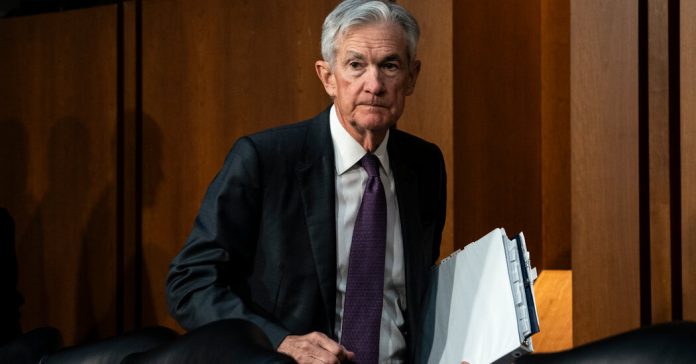
Jerome Powell, the Fed chair, said that “further progress may be delayed” on inflation because of tariffs. Officials kept interest rates steady but signaled they may cut them twice this year.


Reporting from Washington
The Federal Reserve left interest rates unchanged on Wednesday for a second straight meeting, as officials stuck to their previous forecast for two more cuts this year despite bracing for higher inflation and slower growth.
The central bank’s decision to hold interest rates in a range of 4.25 percent to 4.5 percent extends a pause that has been in place since January, following a series of cuts in late 2024 that lowered borrowing costs by a full percentage point.
The Fed voted at an highly uncertain moment for the economy amid an onslaught of policy changes from President Trump since he returned to the White House in January. The upheaval has created complications for the central bank, which is still struggling to stamp out stubbornly high inflation and now must contend with a drastically different set of circumstances as it tries to finish off the job without harming what still appears to be a solid labor market.
In a statement, the Fed noted that “uncertainty around the economic outlook has increased” even as it maintained a positive tone about the state of the economy. It said that economic activity continued to expand at a “solid pace” as the unemployment rate “stabilized at a low level.” Inflation, meanwhile, was “somewhat elevated.”
Officials also shared a new set of economic projections capturing their most comprehensive analysis yet of how their outlook has evolved now that Mr. Trump has begun to implement his economic agenda.
Most officials still expect interest rates to decline this year to a range of 3.75 percent to 4 percent, as was the case when projections were last published in December. But eight policymakers forecast either no additional cuts or just one. Only two thought the Fed would lower rates by 0.75 percentage points.
By the end of 2026, most officials expect interest rates to decline by another half point, to a range of 3.25 percent to 3.5 percent, before falling to around 3 percent in 2027.
Fed officials now see the economy growing only 1.7 percent this year, compared with their initial expectation for a 2.1 percent expansion, and predict the unemployment rate to rise to 4.4 percent. Officials also lifted their forecasts for core inflation, which strips out volatile food and energy prices, to 2.8 percent. Back in December, they expected it to end the year at 2.5 percent, already a big step up from earlier estimates.
Underlying these forecasts is a significant degree of uncertainty about how exactly Mr. Trump’s policies will take shape and how businesses and consumers will respond. Those unknowns have reinforced the Fed’s approach to stand pat for the moment. To cut interest rates again, it wants to see either more tangible evidence that inflation is indeed back on track to its 2 percent target, or signs that the economy is starting to deteriorate sharply.
One of the biggest wild cards is tariffs, which the president has threatened on a scale beyond what many economists and policymakers initially expected. After much flip-flopping, levies on certain imports from Canada, Mexico and China are now in place, along with all foreign steel and aluminum that comes into the United States. Mr. Trump and his advisers are now working on so-called reciprocal tariffs, which are set to be announced on April 2 and aim to match the tariffs that other countries charge on American exports, while also factoring in other penalties like taxes and currency manipulation.
The fear is that these policies, coupled with Mr. Trump’s efforts to slash government spending and deport immigrants, will not only intensify already sticky price pressures but also knock what has been a remarkably resilient economy off course. Taxes and deregulatory measures could help to prop up growth to some extent, which is why the Fed is primarily focused on the net effect of the government’s agenda.
Survey data suggests that Americans have already begun to sour on the outlook while also building in higher expectations about inflation, however. In a notable shift, the president and his advisers have repeatedly refused to rule out a recession, an admission that has jolted financial markets. They have also warned that consumer prices may rise temporarily. That combination would put the Fed in an even more difficult position, given its mandate to keep inflation low and stable and the labor market healthy.
Also on Wednesday, the Fed announced that it would slow the reduction of its roughly $6.8 trillion balance sheet in order to avoid amplifying disruptions that could crop up in funding markets due to the ongoing standoff over the debt ceiling, which limits how much money the government can borrow to meet its financial obligations. The Fed will now cap the amount of Treasury securities it will allow to roll off its balance sheet at $5 billion per month, down from $25 billion. It kept the monthly cap unchanged for mortgage-backed securities. Christopher Waller, a governor, voted against the decision.


Stock investors breathed a sigh of relief on Wednesday, with Wall Street’s major benchmarks climbing after the Federal Reserve chair, Jerome H. Powell, reiterated that the American economy remained on solid footing, and that the Fed was prepared to react if conditions changed.
Fed officials acknowledged that economic uncertainty had increased, raising their inflation forecast and lowering projections for growth, but they left interest rates and projections for future cuts to borrowing costs unchanged.
The Fed did announce changes to its balance sheet policy. Beginning in April, it will slow the pace at which it is reducing its roughly $6.8 trillion portfolio of Treasury and mortgage-backed securities. Jason Pride, chief of investment strategy and research at Glenmede, said that the announcement most likely pushed stocks higher, easing concerns about the risks tied to bank reserves.
“They’ve had a lot of meetings of no changes, and all of sudden they had a meeting where they made a change,” Mr. Pride said. “That change is in the dovish direction, or one that’s supportive of the economy.”
The S&P 500 rose 1.1 percent, recouping its losses from Tuesday.
Wednesday’s gains followed an extended drop for the market over the past month, a wave of selling that had, at one point, left the S&P 500 more than 10 percent below its Feb. 19 peak. Wall Street sentiment has been dampened by concerns that President Trump’s tariffs and a trade war could push prices sharply higher, discourage consumers and damage the economy.
Leading up to Wednesday’s decision, investors were focused on whether central bankers would express concern about the path forward for the U.S. economy. Fed officials did lower their projections for economic growth this year to 1.7 percent, down from previous forecasts of a 2.1 percent expansion. They also projected modestly higher unemployment and inflation.
“These changes are consistent with estimates that have been circulating on Wall Street in recent weeks from banks and macroeconomic research boutiques, and should not have a major impact on financial markets in our view as a result,” said Josh Jamner, senior investment analyst at ClearBridge Investments.
Advertisement
The Federal Reserve left interest rates unchanged on Wednesday for a second straight meeting. The March meeting was the central bank’s most direct acknowledgment to date that President Trump’s policies are set to have a real impact on the economy, stoking significant uncertainty about where inflation, growth and — ultimately — interest rates are headed. Here are the takeaways:
-
Tariffs took center stage during the news conference with Jerome H. Powell. The Fed chair went as far as saying that tariffs likely mean “further progress may be delayed” on getting inflation back to the central bank’s 2 percent target. That recognition materialized in the higher inflation forecasts that officials penciled into new economic projections. By the end of the year, officials estimate that core inflation, which strips out volatile food and energy prices, will stay stuck at 2.8 percent, before declining to 2.2 percent in 2027.
-
Fed officials paired their higher inflation forecast with lower estimates for economic growth, even as they stuck with previous projections that they would be able to lower interest rates by a half point this year, delivering two quarter-point cuts. The range of possible outcomes was wide, however, with eight policymakers forecasting either no additional cuts or just one this year. Only two thought the Fed would lower rates by 0.75 percentage points, or three cuts of a quarter point this year.
-
In recent months, Mr. Powell has been adamant that the Fed is well positioned to respond to sharp shifts in the trajectory for the economy and could afford to be patient about making rate decisions given the solid foundation of the labor market. He reiterated that point, pushing back on the souring of consumer expectations about inflation and economy that has shown up in recent survey data.
-
While the path forward for interest rates and the economy was the main focus of the March meeting, the Fed’s decision to slow the pace at which it is reducing its balance sheet drew some attention. Mr. Powell said the idea was to reduce the possibility of market ructions in funding markets.

Samuel Tombs, chief U.S. economist at Pantheon Macroeconomics, notes that investors may be trying to reconcile the committee’s souring view on economic growth with its unchanged expectation for the path of rate cuts. “Markets don’t buy the hawkish tilt in the 2025 dots; it jars with the new economic forecasts,” he wrote in a note.

Elon Musk, who is advising Trump on massive cuts to government spending, has raised the possibility that the U.S. could send checks to Americans that reflect some of the new savings. Asked about the idea, which theoretically could be inflationary if consumers spend that money, Powell declined to comment..“It’s not appropriate for me to speculate on political ideas or fiscal policy for that matter, so i’m going to pass on that one,” he said.
Advertisement

Interesting tidbit there from Powell: He says that as the Fed is considering the possible impact of tariffs, it assumes “full retaliation” from trading partners.

So far, we haven’t actually seen full retaliation. Many countries have chosen to withhold their fire power and not to retaliate against Trump tariffs, though it’s likely that more will introduce their own tariffs if Trump goes ahead with further levies on April 2.
Even so, NYT found in a recent analysis that the retaliatory tariffs announced by China, Canada and Europe are targeting U.S. industries that employ nearly 8 million Americans — hinting at the potential impact that retaliation could have.
Powell notes that while inflation had declined to near their target range, price increases are now coming from an “exogenous source,” meaning tariffs, of course.
Powell is asked about recent comments from Scott Bessent, the Treasury secretary, about job growth being concentrated in government and “government-adjacent” sectors. “From our standpoint employment is employment,” Powell says.
Powell adds that the government “has a different role” and can think more about distinctions between different sectors.
Powell’s comments are clashing pretty sharply with any claims by the Trump administration and its supporters about the economic benefits of tariffs, at least immediately. “They tend to bring growth down, they tend to bring inflation up,” he says of tariffs.
Advertisement
Without naming Trump, Powell notes that chaos in Washington is roiling sentiment. “We understand that sentiment is quite negative at this time and that probably has to do with turmoil at the beginning of an administration that’s making big changes in policy,” he said.
This has been Powell’s theme all day: “Sentiment has fallen off pretty sharply, but economic activity has not yet.”
Asked about consumer dissatisfaction with their grocery bills, Powell says that is mostly about accumulated price increases over the past several years, not the current rate of inflation.
Notably, while egg prices have continued to soar, overall grocery prices haven’t risen much in recent months.
Powell again underscores the uncertainty of how tariffs feed into inflation, saying it’s very hard to “prove” how much inflationary pressure comes from tariffs. “It kind of has to be, to some extent,” he says, but he adds we’ll know more in a couple of months.
Part of the confusion is because tariffs don’t automatically result in price increases. U.S. importers who pay tariffs have to decide how much of the tariff they absorb themselves, and how much they try to pass on to their consumers or suppliers. Companies make different decisions on this along different timelines, depending on the dynamics in their industry.
Advertisement
Last night, Trump fired two members of the Federal Trade Commission, an independent watchdog that polices unfair and deceptive practices. That immediately stoked renewed fears that Trump might try to target other independent agencies including the Fed, which he has criticized in the past. Powell declined to comment on whether it posed a risk for the Fed, instead referencing his past contention that the president does not have legal authority to fire the Fed chair. He told reporters he had “no desire to change that answer.”
Powell is asked about Wall Street jitters that the Fed may wait too long to assess the net effect of new policies on the economy, before it’s too late to adjust. Powell’s response highlights the Fed’s extremely difficult position: Even when the Trump administration adopts a policy, it has often walked that policy back just as quickly.

Stocks continue to climb as Powell reiterates the current strength of the economy and that he is not yet concerned about a recession on the horizon. The S&P 500 is now 1.3 percent higher for the day.
Powell pushes back at the idea that the Fed faces a trade-off right now between its goal for low and stable inflation and a healthy labor market. “We don’t have that situation right now. That’s not where the economy is at all. It’s also not where the forecast is.”
Advertisement
Asked about the risks of a recession, Powell notes there is always about a one in four chance of a recession. He notes that some private-sector estimates of recession risks have moved up but still aren’t high.
On the unpredictable effects of tariffs, Powell references this now-famous study from 2019 about how washing machine tariffs ended up spilling over into dryers, which were not subject to levies.
The bulk of the question and answer session so far has been devoted to tariffs and trade wars.
Powell says Trump administration policies have filtered into the economic numbers “only in a kind of early way.”
He said that higher goods inflation in recent months could be noise, but it also could be connected with people buying ahead of tariffs or raising prices ahead of tariffs. “Ultimately though it’s too soon to be seeing significant effects in economic data.”
Advertisement
Powell hasn’t mentioned the president by name in this news conference, but he has been surprisingly direct about what his policies have meant for the economy so far: more inflation and more uncertainty.
So far, President Trump has not remarked on the Fed, and the White House did not immediately respond to a request for comment. But White House press secretary Karoline Leavitt told reporters at a briefing earlier Wednesday that “positive economic data continues to pour in,” citing the “immediate impact of President Trump’s pro-growth agenda.” (Leavitt pointed to data — though she didn’t give the source — showing manufacturing had come “roaring back” in February.)
Trump officials have generally been adamant in arguing that tariffs don’t add to inflation. In more recent weeks, however, the president and other officials have acknowledged that their trade policies could be disruptive economically. In an address to Congress last month, Trump said there could be “a little disturbance,” but said “it won’t be much.”
But Powell is a lot clearer about acknowledging the impact of tariffs. He just mentioned “the arrival of tariff inflation.”
Reaction to Powell’s comments in the stock market is still positive; major indexes are higher for the day. But the shift in the Fed’s economic projections “may instill additional fear in markets and Powell will need to thread the needle very carefully as he explains why two rate cuts still seems the most likely scenario,” said Seema Shah, chief global strategist at Principal Asset Management.
That was a pretty striking statement from Powell just now. He explicitly said that tariffs mean that “further progress may be delayed” on inflation.
Advertisement
Advertisement
Advertisement
Advertisement
Advertisement
Advertisement