
Live Updates: Fed Expected to Extend Pause on Rate Cuts
A new set of economic projections will give the clearest sense to date of how officials think President Trump’s agenda will impact the economy.

The Federal Reserve is set to extend its pause on interest rate cuts on Wednesday as President Trump’s aggressive approach to tariffs and other economic policies fuel extreme uncertainty about the outlook for inflation, growth and unemployment.
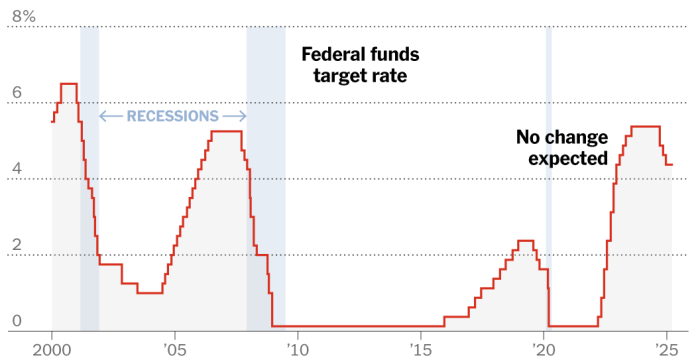
A decision to stand pat would keep interest rates at 4.25 percent to 4.5 percent, a level that was reached in December after a series of cuts in the second half of 2024. The Fed will release its latest policy statement at 2 p.m. in Washington, after which Jerome H. Powell, the Fed chair, will hold a news conference.
Officials at the Fed are in wait-and-see mode, closely tracking the incoming data for signs that progress on inflation is picking back up after a period of stalling out, or that an otherwise solid labor market is starting to crack. What they also want is greater clarity on what exactly Mr. Trump has in store for the economy after a whirlwind of tariff announcements, government spending cuts and deportations.
Here is what to watch for on Wednesday.
-
The dot plot: With the Fed’s pause well telegraphed, perhaps the most important part of the March meeting will come in the form of the central bank’s new “dot plot.” Released quarterly, it tracks what officials expect will happen with interest rates. The last time the dot plot was updated, in December, officials broadly expected two interest rate cuts this year, or a reduction of half a percentage point. That was significantly less than what was predicted in September, when officials saw a full percentage point decline.
-
How many cuts? Some economists are bracing for expectations to be scaled back again, with officials signaling just one cut this year. Others think policymakers will stick with two cuts even as they raise their forecasts for inflation and lower those for growth because of Mr. Trump’s policies. For next year, financial markets are pinning their hopes that there will be at least two rate cuts as a weakening economy prompts the Fed to take action.
-
The Trump factor: Officials are most focused on the net effect of the president’s plans, meaning they are not looking at any one policy individually but taking stock of how each interacts with and potentially offsets another. But given the extent of Mr. Trump’s tariff threats and what he has imposed so far on the country’s biggest trading partners, the global trade war has taken center stage in debates about the economy’s trajectory.
-
A new tariff playbook? The big question for the Fed is whether it will use a playbook that policymakers employed during the central bank’s last brush with large-scale tariffs in 2019, during the first Trump administration. Back then, the central bank ended up lowering interest rates by 0.75 percentage points as a form of insurance against mounting concerns about growth. Inflation at the time was subdued, giving officials flexibility to look past any temporary rise in consumer prices. The Fed does not appear to have that luxury this time around. The tariffs Mr. Trump has put on the table are far more aggressive and could lead to far higher prices for imports along with slowing exports as other countries retaliate. Inflation, meanwhile, is still uncomfortably high.
-
“Look through it”: At an event this month, Mr. Powell began to sketch out how the Fed would approach the tariff situation. “In a simple case where we know it’s a one-time thing, the textbook would say look through it,” he said, referring to a situation in which the Fed would not respond to a tariff-related price rise. But a “series” of bigger shocks when inflation is not yet under control could change that calculus, Mr. Powell warned at the University of Chicago Booth School of Business event.
-
Balance sheet calculations. The Fed’s March meeting could bring about changes to another important instrument in the central bank’s tool kit: the balance sheet. At the last meeting in January, policymakers and their staff discussed the possibility of either slowing or pausing the reduction of the Fed’s roughly $6.8 trillion portfolio of government-backed securities. The reason is to avoid amplifying market gyrations tied to an ongoing standoff over the debt ceiling, which caps how much money the government can borrow.
-
Will the debt limit fight be a factor? The Treasury Department is using what it calls “extraordinary measures” to stay below the debt limit. Eventually those measures will be exhausted, meaning Congress will have to raise the debt ceiling. The Fed has been shrinking its holdings since the middle of 2022 and last May, the central bank slowed its pace of allowing maturing securities to roll off. The Fed is trying to avoid a situation in which the amount of cash flowing in the banking system falls too low and causes short-term disruptions in funding markets, as was the case in September 2019.

In December, Fed officials said they expected economic growth to slow modestly this year, to around 2.1 percent (from 2.5 percent last year) and for the unemployment rate to edge up to 4.3 percent (from 4.1 percent in February). They also expected inflation to remain stubbornly above their 2 percent target.
The economic data hasn’t changed much since then, but surveys of business and consumer sentiment have darkened significantly, and most private-sector forecasts have shifted as a result. It will be interesting to see if policymakers’ forecasts move as well.
In particular, many private forecasters now expect growth to slow this year but for inflation to pick up. If Fed officials say the same, Powell is likely to face questions about why the Fed still expects to cut rates this year — assuming it still does!

One thing I’ll be looking for in the new economic projections is the path for the unemployment rate. Goldman Sachs estimates in a note today that federal spending cuts will be a drag on employment growth of about 25,000 jobs per month over the next year. The jobless rate overall may not rise significantly giving the Trump administration’s efforts to expel immigrants, but it’s a new factor since the last projections.
Regarding immigration, Goldman’s analysts also found that even though deportations have not been moving quickly, immigration has nonetheless slowed more than they anticipated. They expect net annual immigration to decline to 500,000 people this year, down from an annualized rate of 1.7 million in December.
That would put the “breakeven” rate for job creation — that is, the number of new positions needed to soak up the people entering the labor force — at only 80,000 jobs per month by the end of 2025.
Advertisement

President Trump’s trade policy is clouding companies’ financial outlooks. “To the extent that it causes inflation, to the extent that it reduces consumer confidence, that’s not good for Etsy,” Josh Silverman, the online marketplace’s chief executive, said at a conference this month. Tariffs “could hurt discretionary spending,” Michael O’Sullivan, the chief executive at the off-price retailer Burlington, warned investors.
One sector that has been hanging on for lower interest rates is manufacturing, since manufacturing firms’ ability to purchase heavy equipment and machinery is sensitive to borrowing costs. A survey of purchasing managers improved at the end of last year as the Fed began cutting rates, but has recently sagged. Economists generally interpreted a recent surge in industrial production as an effort to get ahead of tariffs, rather than a sign of strength.
How inflation expectations evolve will be critical for the Fed. The central bank has historically argued that it can avoid responding to tariff-induced inflation because those price pressures tend to be temporary. But if levies of the kind that Trump has threatened — and in some cases already implemented — lead to a series of price shocks that feed into persistently higher inflation, the Fed couldy be hamstrung in its ability to respond.
The nightmare scenario for the Fed is one in which inflation reaccelerates, growth stagnates and unemployment rises. So far, “stagflation” remains a remote prospect, but surveys suggest that Americans are growing increasingly concerned. Consumer sentiment has plummeted as expectations about inflation have risen. Powell is likely to face questions about this shift and whether officials are worried that those fears could begun a self-fulfilling prophecy.
Heading into this meeting, Jerome Powell, the Fed chair, and other officials at the central bank have maintained that the economy is still in a good place. That solid foundation gives them the flexibility to wait for greater clarity about how Trump’s policies will impact the economy. But the administration’s plans for tariffs, deportations and spending cuts are wildcards. Powell has said that the Fed is chiefly focused on “separating the signal from the noise.”
Advertisement
Stocks are rising ahead of the Fed’s rate announcement, with the S&P 500 up about 0.8 percent in midday trading. The tech-heavy Nasdaq is up more than 1 percent. With tariffs looming, investors are monitoring the Fed’s latest forecasts and watching for any signs of concern among central bankers about the outlook for the economy.

President Trump has said that tariffs will bring a flood of revenue for the United States. But corporate executives are having trouble navigating the volume of tariff pronouncements and the president’s on-again, off-again approach to trade policy.
Many are turning to the same metaphor: The situation, they say, is “fluid.”
“The tariffs are very fluid right now,” Ron Vachris, chief executive of the retail giant Costco, recently told analysts on an earnings call. “It’s hard to really give any predictions on what we can do, but we are prepared.”
Others feel the same way about the ebb and flow of tariffs:
-
“It’s very fluid right now. It’s almost every day new scenarios coming out, new numbers being calculated.” — Markus Kamieth, chief executive of BASF
-
“The whole tariff situation remains fluid and we have to react.” — Robert Kay, chief executive of Lifetime Brands
-
“Though the environment ahead remains fluid, we will be focused on offsetting any additional tariffs.” — Karen Parkhill, chief financial officer of HP
It is often said that uncertainty is bad for business, muddling hiring and investment plans. The unpredictability of Mr. Trump’s trade policy has played a role in tumbling stock markets and falling measures of consumer and business confidence. Targeted tariffs by other countries in response to Mr. Trump’s moves further cloud the economic outlook, making it trickier for corporate executives, Federal Reserve policymakers and others to react.
“Until we know what’s actually going to go into effect, it will be very difficult for our customers to decide what to do,” Scott Herren, chief financial officer of Cisco Systems, said on a call with investors, after describing the tariff situation — like so many others — as “very fluid.”
Executives are generally eager to talk about liquidity, but not this kind.


The Federal Reserve is expected to keep its key rate steady on Wednesday, after a series of cuts that lowered rates by a full percentage point last year.
That means consumers looking to borrow are likely to have to wait a bit longer for better deals on many loans, but savers will benefit from steadier yields on savings accounts.
Economists don’t expect another rate cut for a while, as the central bank waits for more clarity on an increasingly uncertain outlook given President Trump’s policies on tariffs, immigration, widespread federal job cuts, among other things.
The Fed’s benchmark rate is set at a range of 4.25 to 4.5 percent. In an effort to tamp down sky-high inflation, the central bank began lifting rates rapidly — from near zero to above 5 percent — between March 2022 and July 2023. Prices have cooled considerably since then, and the Fed pivoted to rate cuts, lowering rates in September, November and December.
More recently,Mr. Trump’s inflation-stoking polices could prompt the Fed to delay more rate cuts. But at the same time, longer-term interest rates set by the markets have been drifting down, influencing a wide range of consumer and business borrowing costs.
Auto Rates
What’s happening now: Auto rates have been trending higher and car prices remain elevated, making affordability a challenge. And that is before U.S. tariffs threaten to push prices up even more.
Car loans tend to track with the yield on the five-year Treasury note, which is influenced by the Fed’s key rate. But other factors determine how much borrowers actually pay, including your credit history, the type of vehicle, the loan term and the down payment. Lenders also take into consideration the levels of borrowers becoming delinquent on auto loans. As those move higher, so do rates, which makes qualifying for a loan more difficult, particularly for those with lower credit scores.
The average rate on new car loans was 7.2 percent in February, according to Edmunds, a car shopping website, up from 6.6 percent in December and 7.1 percent in February 2024 . Rates for used cars were higher: The average loan carried an 11.3 percent rate in February, compared with 10.8 percent in December and 11.6 percent in February 2024.
Where and how to shop: Once you establish your budget, get preapproved for a car loan through a credit union or bank (Capital One and Ally are two of the largest auto lenders) so you have a point of reference to compare financing available through the dealership, if you decide to go that route. Always negotiate on the price of the car (including all fees), not the monthly payments, which can obscure the loan terms and what you’ll be paying in total over the life of the loan.
Credit Cards
What’s happening now: The interest rates you pay on any balances that you carry had edged slightly lower after the most recent Fed cuts, but the decreases have slowed, experts said. Last week, the average interest rate on credit cards was 20.09 percent, according to Bankrate.
Much depends, however, on your credit score and the type of card. Rewards cards, for instance, often charge higher-than-average interest rates.
Where and how to shop: Last year, the Consumer Financial Protection Bureau sent up a flare to let people know that the 25 biggest credit-card issuers had rates that were eight to 10 percentage points higher than smaller banks or credit unions. For the average cardholder, that can add up to $400 to $500 more in interest a year.
Consider seeking out a smaller bank or credit union that might offer you a better deal. Many credit unions require you to work or live someplace particular to qualify for membership, but some bigger credit unions may have looser rules.
Before you make a move, call your current card issuer and ask them to match the best interest rate you’ve found in the marketplace that you’ve already qualified for. And if you do transfer your balance, keep a close eye on fees and what your interest rate would jump to once the introductory period expires.
Mortgages
What’s happening now: Mortgage rates have been volatile. Rates peaked at about 7.8 percent late last year and had fallen as low as 6.08 percent in late September. Solid economic data and concerns about Mr. Trump’s potentially inflationary agenda pushed rates a bit higher again, though they’ve steadied in recent weeks.
Rates on 30-year fixed-rate mortgages don’t move in tandem with the Fed’s benchmark, but instead generally track with the yield on 10-year Treasury bonds, which are influenced by a variety of factors, including expectations about inflation, the Fed’s actions and how investors react.
The average rate on a 30-year fixed-rate mortgage was 6.65 percent as of Thursday, up slightly from 6.63 percent the previous week but down from 6.74 percent a year ago.
Other home loans are more closely tethered to the central bank’s decisions. Home-equity lines of credit and adjustable-rate mortgages — which carry variable interest rates — generally adjust within two billing cycles after a change in the Fed’s rates.
Where and how to shop: Prospective home buyers would be wise to get several mortgage rate quotes — on the same day, since rates fluctuate — from a selection of mortgage brokers, banks and credit unions.
That should include: the rate you’ll pay; any discount points, which are optional fees buyers can pay to “buy down” their interest rate; and other items like lender-related fees. Look to the “annual percentage rate,” which usually includes these items, to get an apples-to-apples comparison of your total costs across different loans. Just be sure to ask what’s included in the A.P.R.
Savings Accounts and C.D.s
What’s happening now: Everything from online savings accounts and certificates of deposit to money market funds tend to move in line with the Fed’s policy.
Savers are no longer benefiting from the juiciest yields, but you can still find returns at online banks of 4 percent or more. “The Fed taking its foot off the gas with rate cuts means that these yields are likely to stay high for a while, but it won’t last forever,” said Matt Schulz, chief consumer finance analyst at LendingTree, the online loan marketplace.
Traditional commercial banks’ yields, meanwhile, have remained anemic throughout this period of higher rates. The national average savings account rate was recently 0.6 percent, according to Bankrate.
Where and how to shop: Rates are one consideration, but you’ll also want to look at providers’ history, minimum deposit requirements and any fees (high-yield savings accounts don’t usually charge fees, but other products, like money market funds, do). DepositAccounts.com, part of LendingTree, tracks rates across thousands of institutions and is a good place to start comparing providers.
Check out our colleague Jeff Sommer’s columns for more insight into money-market funds. The yield on the Crane 100 Money Fund Index, which tracks the largest money-market funds, was 4.14 percent as of Tuesday, down from 5.15 percent in February 2024.
Student Loans
What’s happening now: There are two main types of student loans. Most people turn to federal loans first. Their interest rates are fixed for the life of the loan, they’re far easier for teenagers to get and their repayment terms are more generous.
Current rates are 6.53 percent for undergraduates, 8.08 percent for unsubsidized graduate student loans and 9.08 percent for the PLUS loans that both parents and graduate students use. Rates reset on July 1 each year and follow a formula based on the 10-year Treasury bond auction in May.
Private student loans are a bit of a wild card. Undergraduates often need a co-signer, rates can be fixed or variable and much depends on your credit score.
Where and how to shop: Many banks and credit unions want nothing to do with student loans, so you’ll want to shop around extensively, including with lenders that specialize in private student loans.
You’ll often see online ads and websites offering interest rates from each lender that can range by 15 percentage points or so. As a result, you’ll need to give up a fair bit of information before getting an actual price quote.
Advertisement
Although a lot of the attention will focus on the market reaction to Powell’s remarks, the Fed’s rate-setting decisions also affect small businesses, which often have less flexibility in how they access capital than public companies. Small-business sentiment dropped in February after a post-election surge, according to surveys. Bank of America wrote in a research note this week that credit card spending by small businesses has also been slowing.
As central bankers seek clarity on the path for the economy, executives at consumer-facing companies have recently warned that they expect shoppers to pull back on spending because of uncertainty about the future. “They have the fear of the unknown,” Jay Schottenstein, the chief executive at American Eagle Outfitters, told investors last week. “When people don’t know what they don’t know, they get very conservative.”
One thing I’ll be watching for at 2 p.m. is how much disagreement there is among policymakers on the path of interest rates this year. In December, 10 of the 19 Fed officials expected to make two quarter-point cuts this year, with the rest nearly evenly split between cutting by more or less. I wouldn’t be surprised if there’s a wider range of views this time.
With the Fed widely expected to extend its pause on interest rate cuts, most of the attention at 2 p.m. will be on the new set of projections released by the central bank, which show how all 19 officials are thinking about the trajectory for interest rates, inflation, growth and unemployment. The last time these forecasts were updated, in December, most officials predicted two cuts this year, for a total half-percentage point reduction in borrowing costs. That was half of what they thought in September and reflected their expectation that inflation would end 2025 higher than initially thought.
Some economists expect officials to scale back the number of rate cuts to just one this year, as they pencil in the prospects of higher inflation. Others think most will stick with two cuts for the year in recognition of a weakening outlook for growth.
Advertisement

President Trump has never been shy about criticizing the Federal Reserve, frequently seeking to pressure the nation’s central bank into reducing interest rates more swiftly.
“Interest Rates should be lowered, something which would go hand in hand with upcoming Tariffs!!!,” Mr. Trump posted on Truth Social last month, adding: “Lets Rock and Roll, America!!!”
But the Fed is expected to see things differently on Wednesday — choosing to hold rates steady in the face of rising prices and slowing growth — in a move that seems destined to stoke Mr. Trump’s anger.
At the heart of the tension are Mr. Trump’s tariffs, which he has promised to apply more expansively beginning April 2. The White House contends its protectionist policies can rejuvenate American manufacturing and reduce the country’s reliance on imports, but economists believe that Mr. Trump risks touching off a protracted global trade war that will badly harm the U.S. economy.
The latest dour projection arrived Tuesday, when Fitch Ratings cut its U.S. growth forecast for this year to 1.7 percent from 2.1 percent. It explicitly pointed to Mr. Trump’s tariffs — and the “huge uncertainty” around them — as two of the drivers behind a potential economic slowdown and short-term rise in prices.
The uncertainty is likely to freeze any rate cutting at the Fed, perhaps straining an already tortured relationship between Mr. Trump and Jerome H. Powell, the man he handpicked to serve as chair of the central bank in 2017.
In his first term, the president described Mr. Powell as the “enemy,” and blasted his colleagues as “boneheads,” in a bid to browbeat the Fed into slashing interest rates. Mr. Trump at one point even considered firing Mr. Powell, raising fears that the White House might try to undermine the Fed’s political independence.
Soon after returning to the White House, the president revived his attacks: He said, again, that he would “demand that interest rates drop immediately,” and one of his leading advisers — the tech billionaire Elon Musk — signaled support for an audit of the central bank. When the Fed chose to hold rates steady at its last meeting, Mr. Trump charged anew that Mr. Powell and the Fed had “failed to stop the problem they created with inflation.”
“If the Fed had spent less time on DEI, gender ideology, ‘green’ energy, and fake climate change, Inflation would never have been a problem,” Mr. Trump wrote in a post on Truth Social.
Federal Reserve officials are scheduled to release their first set of economic projections this year, alongside their interest rate decision, on Wednesday. Those forecasts will offer a fresh glimpse of the trajectory for monetary policy at a highly uncertain moment for the central bank.
Policymakers paused interest rate cuts in January after reducing borrowing costs by a percentage point in the latter half of last year. They are expected to again stand pat on Wednesday as they await greater clarity on how far President Trump will push his global trade war and to what extent he will follow through on other central aspects of his agenda, including slashing government spending and deporting migrants.
The big question now is when — and to some extent whether — the Fed will be able to restart cuts this year.
When the Fed last released quarterly economic projections in December, officials penciled in two rate cuts that would reduce borrowing costs by half a percentage point in 2025. But economists now expect Mr. Trump’s policies to lead to more intense price pressures and slower growth, a tough dynamic for the central bank and one that could prompt policymakers to scale back how many cuts they project going forward.
Here’s what could change and how to interpret those updates.
The dot plot, decoded
When the central bank releases its Summary of Economic Projections each quarter, Fed watchers focus on one part in particular: the dot plot.
The dot plot will show Fed policymakers’ estimates for interest rates through 2027 and over the longer run. The forecasts are represented by dots arranged along a vertical scale — one dot for each of the central bank’s 19 officials.
Economists closely watch how the dots are shifting, because that can give a hint about where policy is heading. They fixate most intently on the middle, or median, dot. That is regularly quoted as the clearest estimate of where the central bank sees interest rates going over a given time period.
The central bank is trying to achieve two things when it sets policy: low, stable inflation and a healthy labor market.
When it perceives elevated inflation to be a concern, it raises interest rates to make borrowing money more expensive, which cools the economy. By taking steam out of the housing and labor markets — as it did between March 2022 and July 2023 — higher rates helped to weaken demand and made it harder for companies to raise prices without losing customers, eventually weighing on inflation.
With inflation more in check, officials began cutting rates in September, kicking off with a big half-percentage-point reduction. At the time, the Fed’s chair, Jerome H. Powell, billed it as a move that would help to safeguard a strong economy, rather than a panicky response to unexpected weakness. The Fed lowered interest rates twice more in 2024, bringing them down to the current level of 4.25 percent to 4.5 percent.
Based on shifting perceptions about the risks around inflation and growth, economists broadly expect officials to pencil in either one or two quarter-point cuts for this year.
Are interest rates still restrictive?
When reading the dot plot, it’s important to pay attention to where interest rate estimates fall in relation to the longer-run median projection. That number is sometimes called the “natural” or “neutral” rate. It represents the theoretical dividing line between monetary policy that is set to speed up the economy versus a policy meant to slow it down.
The neutral estimate has steadily ticked higher in the past year and in December stood at 3 percent.
At the last meeting, Mr. Powell described rates at their current level as “meaningfully restrictive,” suggesting the Fed sees its policy settings as continuing to weigh on the economy and helping to bring down inflation. Economists will be watching whether the chair changes his tune on that point. If he suggests that rates are no longer as restrictive, it could mean the Fed now sees less capacity to lower rates with inflation still too high.
Inflation concerns resurface
Price pressures have eased significantly since peaking in 2022, but inflation overall has yet to return to the Fed’s 2 percent target. Progress toward that goal has been very bumpy in recent months, and with Mr. Trump seemingly committed to an aggressive tariff regime, there is increased concern about this progress could get thrown even further off course.
Fed officials moved their estimates for inflation sharply higher in December, with some already starting to layer in assumptions about what to expect from another Trump administration at that point. Back then, the majority expected the core personal consumption expenditures price index — which strips out volatile food and energy items and is the Fed’s preferred gauge — to hover at 2.8 percent by the end of the year. As of January, it stood at 2.6 percent.
Policymakers could raise those estimates again on Wednesday given the scope and scale of Mr. Trump’s plans to date.
Economists and policymakers broadly agree that tariffs lead to higher consumer prices, but whether those increases lead to persistently higher inflation is not entirely clear. Much will depend on how extensive the tariffs end up being, how long they are kept in place and ultimately how businesses and consumers respond.
Is the soft landing at risk?
As much as economists and policymakers are worried about resurgent inflation, they are also concerned about growth, despite the labor market having been much more resilient than expected despite soaring inflation and elevated interest rates.
In December, Fed officials expected the economy to grow 2.1 percent this year, a more moderate pace than 2024 but still a healthy clip. They also expected the unemployment rate to steady around 4.3 percent, 0.2 percentage point higher than its level as of February.
Estimates pertaining to growth are likely to be lowered in the latest set of projections, while unemployment forecasts could rise as officials factor in Mr. Trump’s plans to cull the federal work force and cut spending more broadly.
Americans’ feelings about the economy have already significantly soured on fears that all of the uncertainty surrounding Mr. Trump’s trade policy will also lead businesses to halt investment and hiring. Still, most economists do not expect a recession, given the economy’s strong foundation.
Advertisement

The stock market has fallen fast over the past month. Business and consumer sentiment is souring, and investors are afraid that economic data will soon start to show deeper cracks.
The question on Wednesday: Will the Federal Reserve also express concern about the path ahead?
So far, Fed officials have largely avoided commenting on an uncertain outlook while current economic data remain solid. A healthy labor market has allowed the central bank to continue to point to economic resilience as it holds interest rates high in response to stubborn inflation.
But in addition to announcing its decision on interest rates at its monthly meeting on Wednesday, the Fed will publish officials’ first economic projections since December.
“Since then, the U.S. economic environment has changed dramatically,” said Matt Colyar, an economist at Moody’s Analytics.
Trump administration officials have largely brushed off investors’ concerns, saying that the economy remains on sound footing and that a modest pullback from recent stock market highs is nothing to worry about. The S&P 500 briefly entered a correction last week after four straight weeks of losses. The index is 8.6 percent lower than its record high last month, and down more than 4 percent so far this year.
Treasury Secretary Scott Bessent recently suggested that earlier proposals by the government to introduce hard-line tariffs on trading partners were likely to be softened as negotiations progressed, and that this could offer a tailwind for the stock market.
Investors are squarely focused on whether the economy can withstand the current period of fading growth expectations and rising recession worries, at least until more business-friendly policies like tax cuts and deregulation are settled on and there is more certainty around tariffs.
At the beginning of March, investors expected the Fed to next cut interest rates in June, based on prices in interest rate futures markets. As of Tuesday, those expectations had been pushed back six weeks to July.
But certain interest rates have started to come down even without Fed action. As growth worries have mounted, longer-dated market interest rates have fallen, making things like mortgages and auto loans cheaper.
In effect, this decline is doing some of the same job that the Fed’s cutting interest rates would do and is buying the central bank some time while inflation remains sticky.
Lower interest rates are typically seen as being beneficial for the stock market, but the recent decline in rates has not helped lift companies’ share prices
When rates fall because of fundamental concerns about the economy, the forecast for the companies in the stock market is also gloomy and their valuations typically fall.
The clouds have been gathering over corporate America. Chief executives from businesses like Delta Air Lines, Dollar General and Macy’s are warning that consumers have begun to struggle.
And retail sales in February were lower than expected, with January’s preliminary figure revised down in the latest data.
The Federal Reserve Bank of Atlanta’s growth forecast for the first quarter is minus 1.8 percent.
The U.S. dollar is 4 percent lower just in March, on course for its worst month since November 2022. As the dollar weakens, the impact of President Trump’s tariffs on domestic companies and consumers intensifies. Investors have sought out the safety of gold, which rose past $3,000 per troy ounce this week for the first time.
Foreign investors have already begun to pivot away from U.S. markets. Analysts at Bank of America said their latest global survey of fund managers showed a sharp drop in the rosy expectations that they had started the year with, but not yet to the point that they were expecting a recession, even though worries over a possible downturn had risen. Analysts labeled the current sentiment a “bull crash.”
Should Fed officials signal on Wednesday that they are becoming more concerned about the economy and that the “dot plot” of interest rate forecasts suggests deeper cuts than investors expect, the stock market could fall even further.
Futures on the S&P 500, which give investors the ability to trade before exchanges officially open, pointed to a modest rise on Wednesday, paring some of its 1 percent slide on Tuesday.
“The Fed seems committed to sitting on its hands for the time being, but the dot plot will force them to ‘guesstimate’ whether they’ll cut rates this year and by how much,” said Kristina Hooper, chief market strategist at Invesco. “With so much up in the air, it’ll be interesting to see their expectations.”
Mr. Colyar at Moody’s is among those who expect the Fed to hold interest rates steady until the second half of the year, when he expects the mounting tariff war to have slowed growth to the point that the central bank takes action.
“The timing for those moves will inch closer if the economy starts flashing red,” he added.