OBR head’s resignation leaves potential landmines for Reeves
 PA Media
The shock resignation came for a very specific reason – the early release of Budget information – but the saga surrounding the Office for Budget Responsibility (OBR) will continue with a series of decisions the chancellor will have to make over Richard Hughes’s replacement.
Firstly, Rachel Reeves will have to find a respected and credible economist to run the OBR.
There are several candidates who might fit the mould of fiercely independent bean counters.
The list will be carefully watched by the markets for any departure from the normal model. The problem is there is some political pressure to do just that.
One of the points of tension was the refusal of Mr Hughes to give credit to the government for “pro-growth” policies.
He had said he would not score any policy unless it was material in its impact on the economy. In the event, none reached the 0.1% of national income threshold.
It is a careful balancing act, however.
Any perceived interference with the OBR’s independence could affect market credibility too, and, for example, raise UK government borrowing costs.
When I saw the now-departing chairman on the evening of the Budget last week, he was clearly mortified by the responsibility of his organisation for the early release of Budget information.
While it is no surprise to me that Mr Hughes took the honourable decision to resign for an error identified as the fault of a junior member of staff, it was not the only issue vexing him.
He was a fierce defender of the independence of his organisation from political and ministerial pressure – from right and left. That was seen during the Liz Truss mini budget episode, and in recent weeks too.
There had been a drumbeat of noise from the right and the left, and now from the centre too, about the restrictions the OBR system placed on the freedoms of elected governments.
The OBR was in some corners seen as an arm of a “woke deep state”, and by others as an “agent of austerity”.
Budget tension
There had, however, been tension over the Budget.
Changes had already been planned. The chancellor had also announced that it would only respond to the OBR’s forecasts once a year.
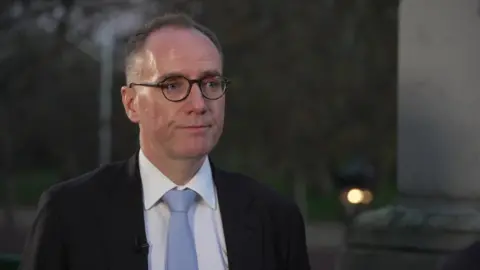
Mr Hughes told me: “We’ll still be producing two full economic and fiscal forecasts looking five years out, twice a year, now and in the spring.
“But with this change of legislation, the government doesn’t feel obliged to respond to those forecasts with policy in the spring. It’ll be more like a health check on the economy and the public finances.
“There’ll be no loss of transparency from the forecast documentation that we’ll produce.”
The precise design of the new approach to the OBR’s forecast will matter. If there is a marked improvement in the public finances in spring, will the chancellor really avoid spending any “surplus” ahead of crucial local elections?
Around the Budget, the OBR scored an improvement to the UK economy as a result of the use of AI by the end of the decade. The OBR also used new powers to initiate a tricky costing for the ballooning cost of special educational needs in England, inviting a backlash from some Cabinet ministers.
For some this underscores its ability, like no campaign or Cabinet minister initiative, to focus government priorities. Mr Hughes denied the 35-member forecasting group was too powerful.
“The powers given to us are those given to us by Parliament in an Act of Parliament, and that’s to produce a forecast. Chancellors set their own targets. They set their own policies. Chancellors are in charge of £1.5 trillion worth of revenue and £1.5 trillion worth of spending,” he told me.
“If they don’t want to meet their targets, they can change them, which we’ve seen chancellors do in the past as well.
“All we do is produce a baseline forecast, cost government policies when they give them to us, and we give them an assessment about whether we’re up there, in line and on track to meet those targets.”
In terms of the government’s difficulties over the run up to this Budget, Mr Hughes may also take some important details of the timing of various claims around the state of the public finances to his gardening leave.
He had been due to address the Treasury Select Committee this morning, that has now been cancelled. He recognised the publication of his clarification table on Friday of the evolution of the forecasts was unusual.
Over five years at the OBR Richard Hughes faced five chancellors, and his relationship with all of them was designed to help promote UK economic stability.
The new relationship with a different OBR is an opportunity for the government, but a big risk too.